
YouTube Automation: The Complete Guide to Building a Channel Without Being on Camera (2026)
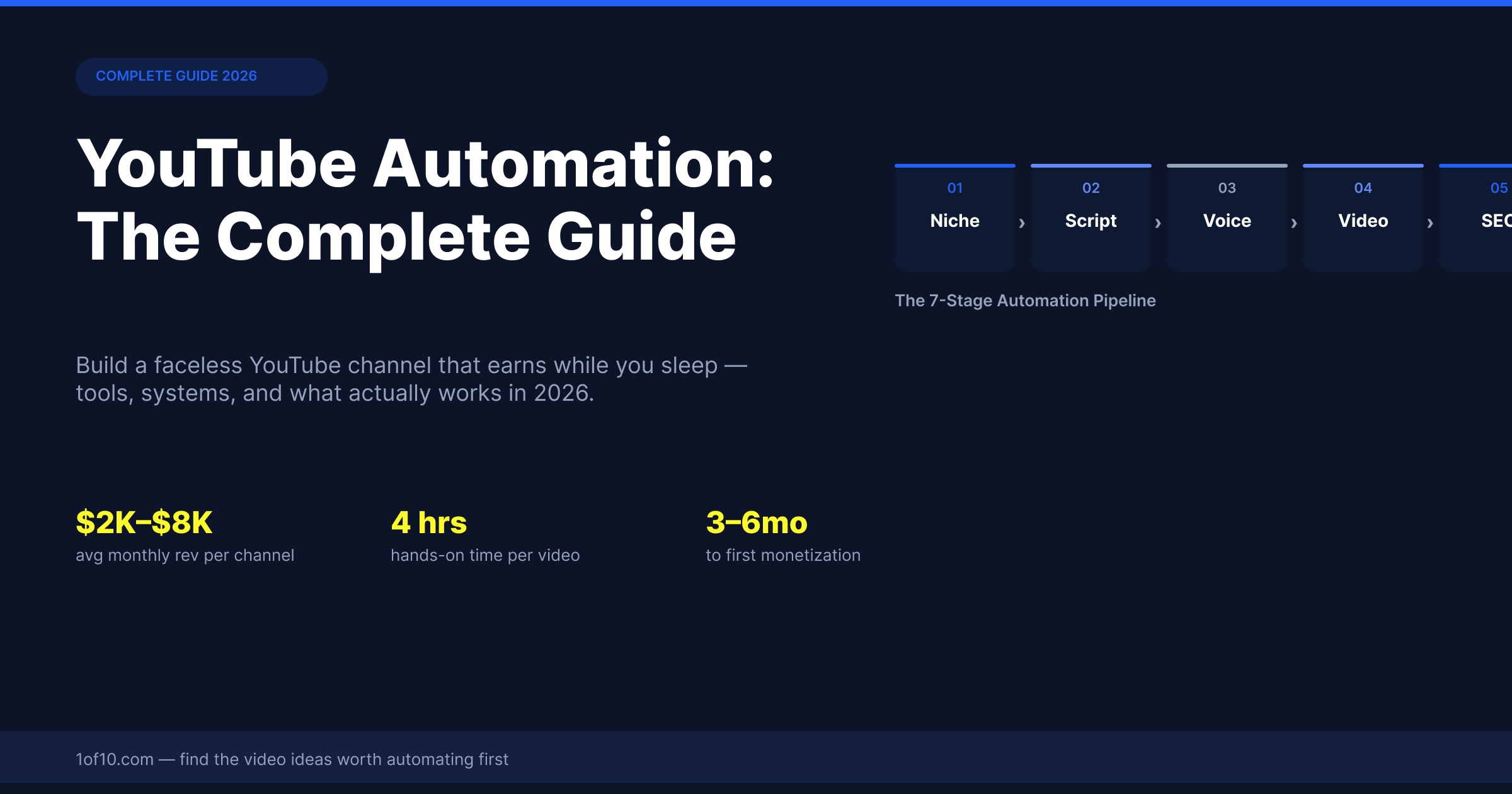
YouTube automation gets talked about in two completely different ways.
The first version sounds like a scam: buy a course, hire some freelancers, sit back and collect passive income while faceless AI videos rack up millions of views. Most of the people selling this version are making more money from the course than from any YouTube channel.
The second version is what actually works: a systematic content operation where repeatable tasks are handled by AI tools or contracted workers, the creator focuses on strategy and quality control, and the channel grows because the underlying content is genuinely good.
This guide is about the second version. It covers what YouTube automation actually is in 2026, how to build a channel that runs it properly, what the economics look like, and where most automation attempts break down.
What YouTube Automation Actually Means
YouTube automation is the process of removing yourself as the bottleneck from as many stages of channel production as possible.
A traditional YouTube channel requires one person to research ideas, write scripts, film footage, record voiceover, edit the video, design a thumbnail, write the title and description, and publish. Most channels live or die on how much one person can do, which is why most channels publish inconsistently and burn out within six months.
An automated channel distributes those tasks. Some go to AI tools. Some go to contracted specialists. The channel operator focuses on the decisions that require judgment: which topics to pursue, quality control at each stage, channel strategy.
The result is a channel that can publish two to five videos per week without the founder being on camera or handling every production task.
Importantly, this is not a new idea. Media companies have operated this way for decades. YouTube automation is simply applying a publishing operation model to a single-channel business. If you are wondering whether it is too late to start YouTube this way, the honest answer is that the automation model lowers the barrier considerably — what matters more than timing is niche selection and topic quality.
What Changed in 2026
Two things shifted the automation landscape in 2026.
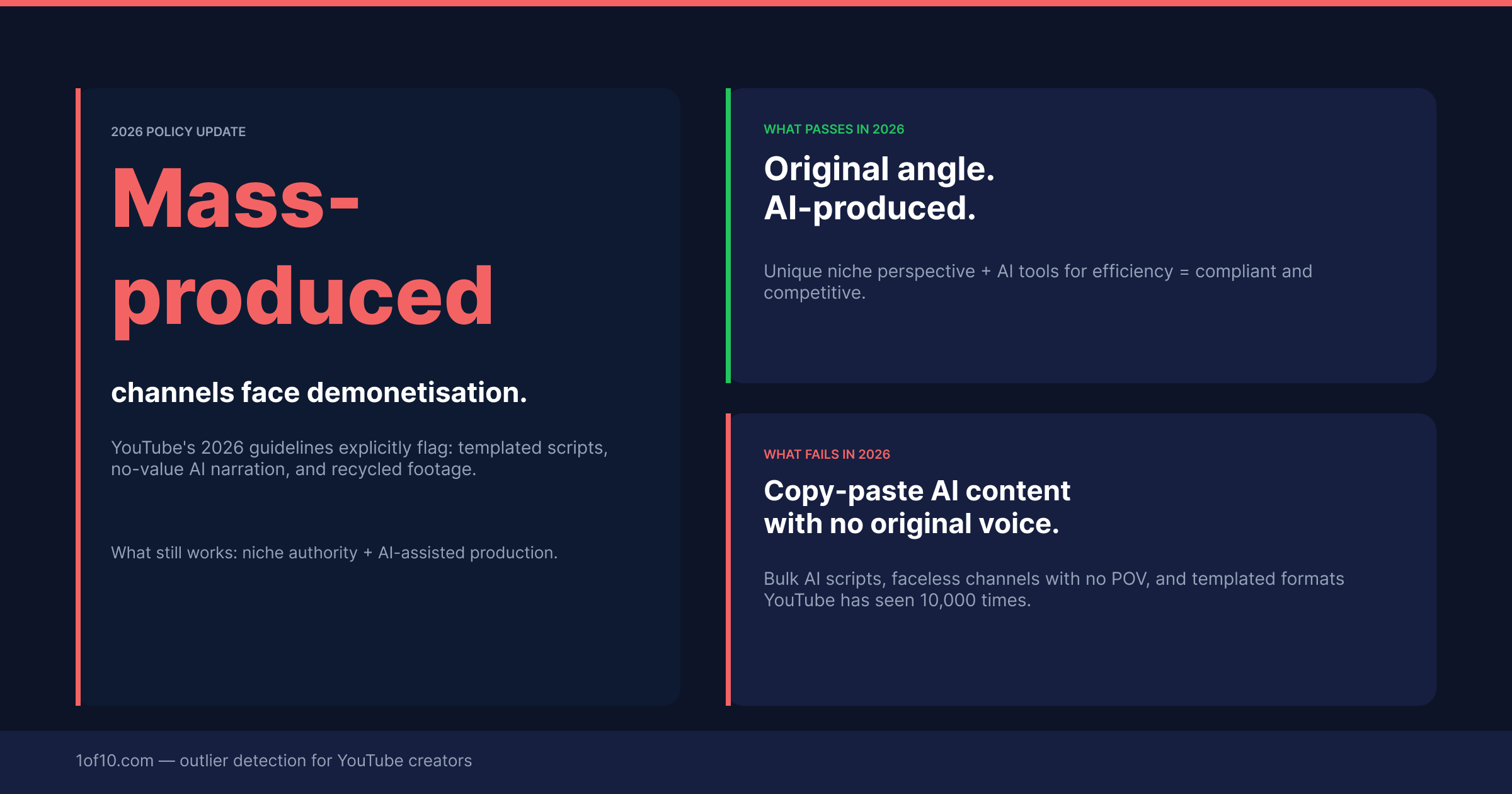
YouTube's July 2026 monetisation policy update specifically targeted "inauthentic" mass-produced content. Channels that publish high volumes of AI-generated content with no original editorial perspective are being flagged, demonetised, or removed from recommendation systems. The policy does not penalise automation itself. It penalises automation without quality control.
AI tool quality improved significantly. The voiceover tools, video generation tools, and thumbnail tools available in 2026 produce substantially better output than two years ago. This raises the bar for competition but also makes it more viable to build a genuinely high-quality automated channel.
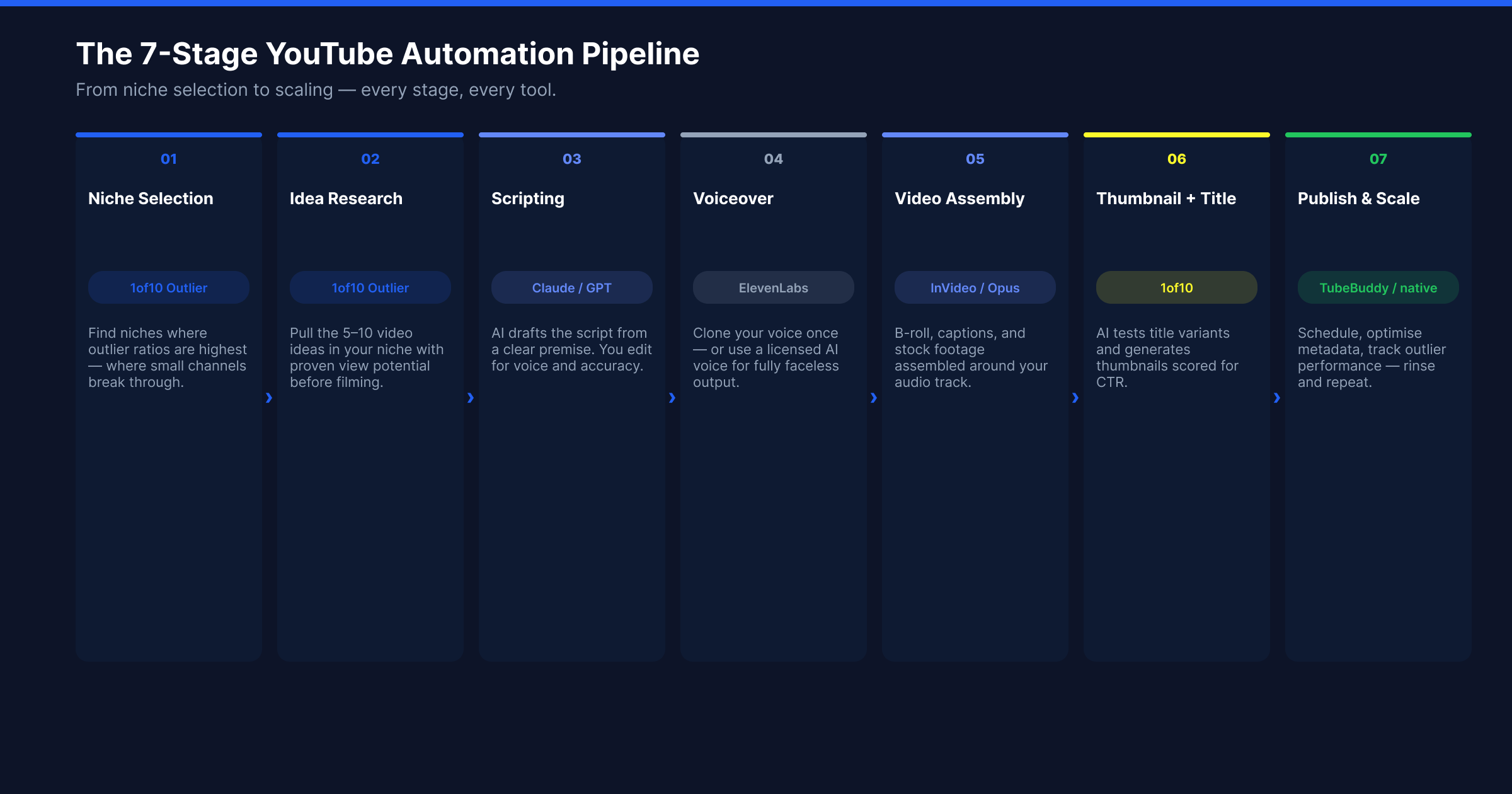
The 7-Stage Automation Framework
Stage 1: Niche Research
This is the most important stage and the one most automation guides skip.
The right way to choose a niche for an automation channel is to validate it with performance data before committing. Specifically, you want to see whether videos in that niche are generating outlier performance — outperforming their own channel's average at a meaningful rate.
**1of10** lets you scan any niche and see which videos are outperforming their channel averages. The niche explorer feature is purpose-built for this.
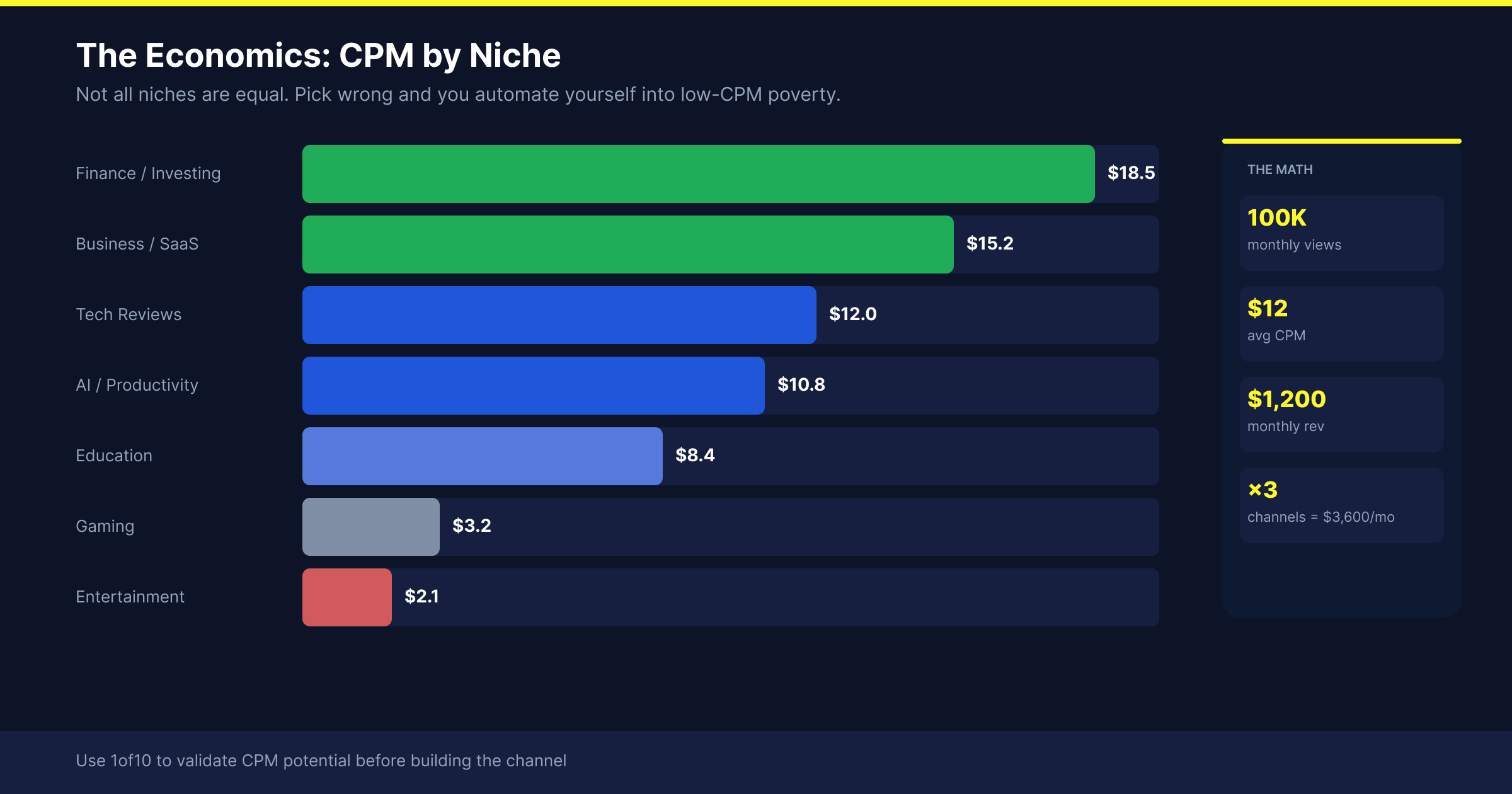
CPM ranges by niche:
| Niche | CPM Range |
|---|---|
| Personal Finance / Investing | $15–45 |
| Tech and AI Tools | $8–20 |
| Software / SaaS Reviews | $10–20 |
| Business and Entrepreneurship | $10–20 |
| Health and Longevity | $8–15 |
| Career and Productivity | $6–12 |
| History and Documentary | $5–10 |
| Gaming (strategy) | $3–8 |
| General Lifestyle | $1–3 |
Stage 2: Topic Selection
Run outlier research weekly. Build your content calendar from the topics with the strongest signals. The advanced filters let you narrow outlier results by performance threshold, time window, and niche category.
Stage 3: Script
AI scripting has reached the point where it can produce a solid structural draft for most content categories. The practical workflow: use AI to generate a detailed outline and rough draft, then edit for accuracy, original perspective, and voice. Plan for approximately 40–60% of the script to be rewritten.
Stage 4: Voiceover
ElevenLabs is the current standard for synthetic voice quality. Murf is a solid alternative with a broader voice library. Descript allows you to record your own voice and use it for AI-generated narration.
If your niche rewards personality and relationship, an AI voice will consistently underperform a real presenter. If your niche is primarily informational, high-quality AI voiceover converts nearly as well as a human narrator.
Stage 5: Video Production
For tutorial and software content: screen recording with commentary narration.
For listicle and explainer content: stock footage plus motion graphics. Storyblocks and Pexels provide royalty-free footage. Tools like InVideo AI can assemble footage sequences from a script automatically.
For documentary-style content: stock footage with strong narration and graphics is the standard automated approach.
Stage 6: Thumbnails
The thumbnail is the one stage of automated production where most automation channels underinvest and pay for it with permanently suppressed CTR.
For automated channels, the objective is not to design thumbnails manually but to generate thumbnail options that are based on what is already getting clicks in your niche. 1of10's **AI YouTube thumbnail generator** does this specifically for YouTube. The guide to YouTube thumbnail fonts covers the design principles behind what makes automated thumbnails work. Pair 1of10's generation with YouTube Studio's native A/B testing to validate each variant before it becomes your channel default.
Stage 7: Titles and Publishing
The AI YouTube title generator produces consistent quality across all publications because it works from the same input framework every time. YouTube's scheduling feature handles timing.
The Economics of a YouTube Automation Channel
The CPM reality. A channel in the personal finance niche with $20 CPM earns approximately $9–11 RPM. At 100,000 views per month, that is $900–$1,100 from ad revenue alone.
The production cost reality. A fully outsourced automation channel runs $500–$2,000 per month. An AI-first automation channel using the tools described above runs $100–$300 per month.
The timeline reality. Reaching YouTube Partner Program requirements on an automated channel with consistent twice-weekly publishing typically takes four to eight months. The guide on how to reach 4,000 hours watch time covers the topic-selection and format choices that accelerate this. Reaching meaningful revenue ($1,000-$2,000 per month from ads alone) takes eight to eighteen months depending on niche CPM and view growth.
| Stage | Tool | Monthly Cost |
|---|---|---|
| Niche and topic research | 1of10 | Free trial / paid |
| Script drafting | Claude or ChatGPT | $20 |
| Voiceover | ElevenLabs | $22–99 |
| Video assembly | InVideo AI | $25–60 |
| B-roll footage | Storyblocks or Pexels | $15–20 / Free |
| Thumbnail generation | 1of10 | Included |
| Title generation | 1of10 | Included |
| Editing assistance | Descript | $24 |
| Analytics | YouTube Studio + TubeBuddy | Free / $9 |
The channels that fail in this timeline are almost always failing at Stage 2 (topic selection) or Stage 6 (thumbnails). They are producing consistent volume on topics the algorithm is not pushing, with thumbnails that do not capture clicks. Volume without algorithmic momentum generates almost nothing.
Multiple revenue streams matter. Ad revenue is the floor, not the ceiling. Channels that reach $10,000 per month are almost always running affiliate marketing alongside ad revenue, and often digital products or sponsorships as well. Build for these from the beginning even if they take time to activate.
The Mistakes That Kill Automation Channels
Picking a niche by CPM rate alone. Finance has great CPM but it is saturated and competitive. The right niche has acceptable CPM and current algorithmic momentum. Validate with outlier data before committing.
Removing all human editorial judgment. YouTube's 2026 policy changes specifically target this. The channels that automated themselves into a corner are the ones that published without any human review of quality or originality. Every video needs a human quality check before publishing.
Treating the thumbnail as an afterthought. The production workflow described above ends with distribution. The thumbnail determines whether anyone clicks. A single CTR percentage point improvement across a channel's entire video library is the difference between modest growth and strong growth. Do not rush this stage. Understanding what a good click-through rate on YouTube actually looks like for your niche is the baseline you need before optimising.
Publishing at volume without any topic validation. One hundred videos on topics the algorithm is not pushing is just one hundred chances to fail. Twenty videos on topics with validated outlier momentum in your niche gives the algorithm twenty chances to push your content. Quality of topic selection beats quantity of production every time.
Building a channel with no unique angle. The automation channels succeeding in 2026 are not just producing content. They have a specific perspective or format that differentiates them within their niche. A history channel covering unusual local history stories that national channels ignore. A finance channel covering the intersection of personal finance and specific career tracks. The differentiation is editorial. Automation handles production. You handle positioning.
Is YouTube Automation Worth It in 2026?
Yes, with a specific definition of "worth it."
It is worth it if you approach it as building a media business, not as passive income. The channels that build to $5,000–$20,000 per month are operated by people who take content strategy seriously, who quality-check every output, and who iterate based on performance data.
The automation handles volume and consistency. You handle judgment and strategy. That division of labour is what makes the model work.
Start with the research layer. Validate your niche using 1of10 before you invest a dollar in production.
More comparisons: