
How to Get Subs on YouTube: What Actually Grows a Channel in 2026
How to get subs on YouTube, in one line: make one video that beats your channel's average by a wide margin, then give everyone who watches it a reason to stay. Subscribers do not arrive at a steady rate. They arrive in bursts, and each burst traces back to a single video. Everything below is built around producing that video on purpose.
Why do subscribers come in bursts instead of on a schedule?
Open the subscribers report in YouTube Studio on any channel older than six months and you will see the same shape: a flat line, a spike, a slightly higher flat line, another spike. The spikes are single videos that beat the channel's normal reach. The flat parts are the "consistent" uploads everyone tells you to make.
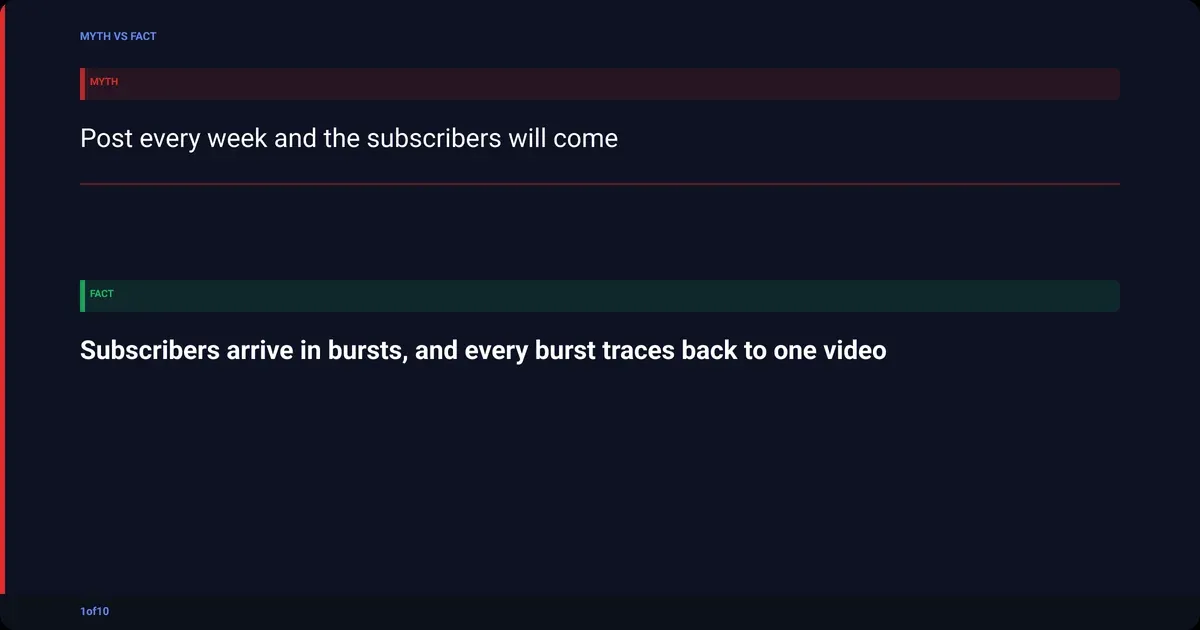
Across 1of10's outlier database, the videos that earn a multiple of a channel's usual views are the same ones that move its subscriber count. Consistency keeps you in the game. Outliers grow the channel.
That changes the job. Instead of "how do I post more", the question is "what did the last spike look like, and how do I make another one". 1of10's outlier finder exists for that question: it shows which videos in your niche are beating their channel's average right now, so your next upload can use a format that already pulls subscribers.
Three things follow:
- A subscriber is a bet on your next video. The spike sets the expectation; the channel has to match it.
- Reach comes first. Nobody subscribes to a video they were never shown, so packaging sits upstream of every other tactic.
- Your best video should sell the channel. End screens and playlists on the spike video do more than the same elements on ten average uploads.
How to get subs on YouTube: the five levers that move the number
Each of these either widens the top of the funnel (more people see the video) or tightens the bottom (more viewers become subscribers). None of them needs a budget or a big channel.
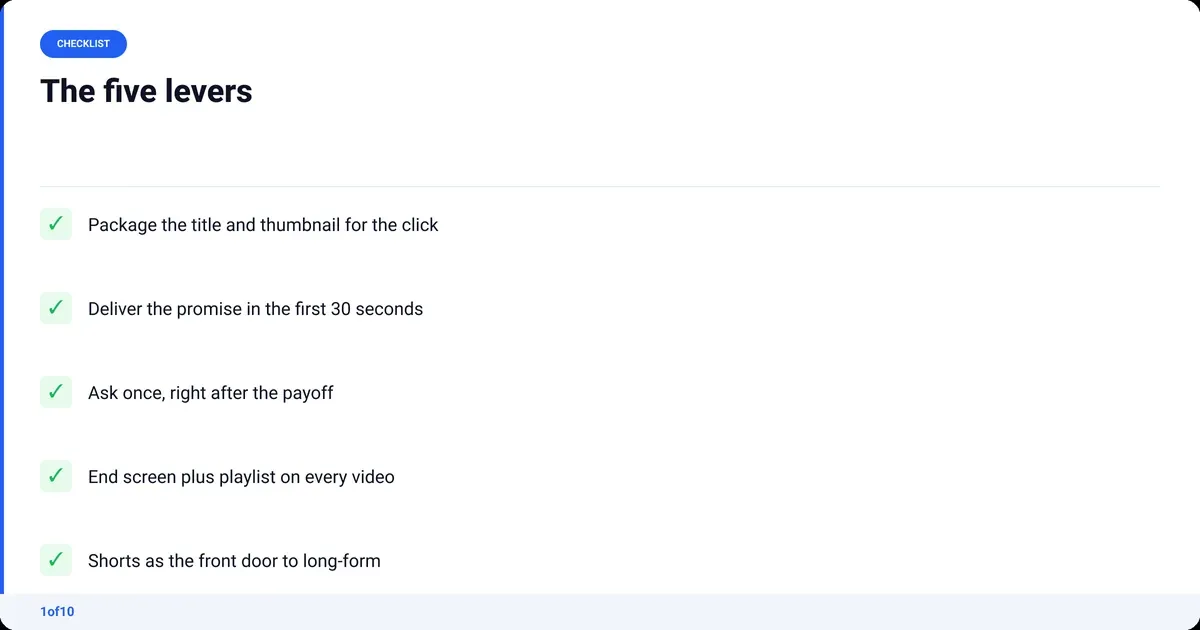
- Package for the click. Title and thumbnail decide whether impressions turn into views. Write the title before you record, make the thumbnail one readable idea, and check your click-through rate against a good YouTube CTR for your channel size. Change both after upload if the numbers stall.
- Win the first 30 seconds. Deliver what the title promised immediately. No channel intro, no "before we start". Early retention decides whether YouTube keeps recommending the video, and recommendation is where the burst comes from.
- Ask once, at the right moment. A subscribe request works when it lands right after you gave the viewer something. After the payoff, never in the first 10 seconds. One ask per video, tied to what the next video will give them.
- Use end screens and playlists. End screens run in the last 5 to 20 seconds of any video over 25 seconds long, with up to four elements including a subscribe button, per YouTube Help. Point one element at the video most likely to earn a second watch, and put the current video in a playlist so autoplay stays on your channel.
- Feed long-form with Shorts. Shorts reach people who have never seen you. A Short that ends on an open question, linked to the long video that answers it, moves cold viewers into the session where subscriptions happen.
| Lever | Widens reach | Converts viewers | Where to check it |
|---|---|---|---|
| Title and thumbnail | Yes | No | Impressions, CTR |
| First 30 seconds | Yes (via recommendation) | Yes | Audience retention |
| Timed ask | No | Yes | Subscribers per video |
| End screens and playlists | No | Yes | End screen click rate |
| Shorts to long-form | Yes | Partly | Shorts traffic source |
How to earn more subscribers from the videos you already have
You do not need a new upload to test this. Sort your videos by subscribers gained in YouTube Studio, open the top three, and check: is there an end screen, does it point at your strongest video, does the description link a playlist. Then re-title anything with a CTR under your channel median. Old videos still earn subscribers when their packaging improves.
How can I get 1,000 subscribers on YouTube?
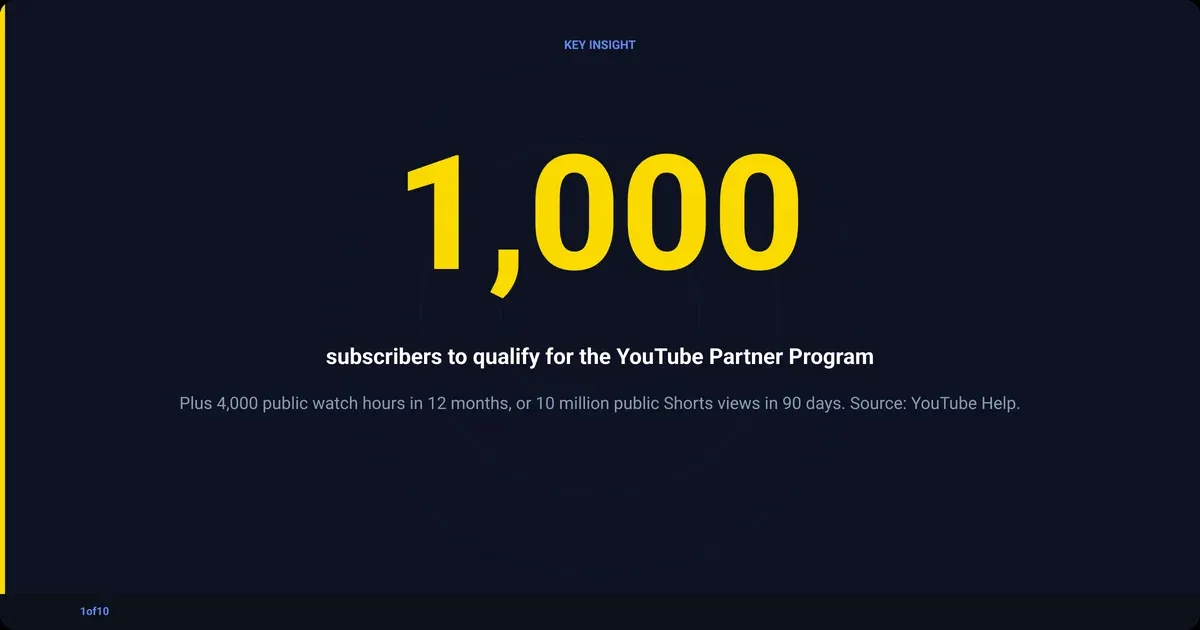
The first 1,000 subscribers matter because that is the subscriber count YouTube requires for the Partner Program, alongside 4,000 public watch hours in the last 12 months or 10 million public Shorts views in the last 90 days (YouTube Help). The full detail is in the YouTube Partner Program guide.
| YPP route | Subscribers | Plus | Window |
|---|---|---|---|
| Long-form | 1,000 | 4,000 public watch hours | Last 12 months |
| Shorts | 1,000 | 10 million public Shorts views | Last 90 days |
Getting there is a systems problem, not a luck problem. This is the plan for a channel starting from zero.
How to get your first 1,000 subscribers, step by step
- Pick a niche with room. Balance three things: your genuine interest (you will be here for a year before it pays), total addressable market (are the top creators pulling hundreds of thousands of views, or a few thousand?), and competition. You will not find an empty niche in 2026, so carve a micro-niche with an angle: not "cooking", but "15-minute meals for students on a budget".
- Find the outliers in and around your niche. Study the videos that beat their channel's average, both inside your topic and in adjacent ones. A photography channel learns from videography and graphic design. Look for repeating patterns in titles, formats and topics, then adapt the pattern with your own twist.
- Validate before you record. Check that the idea worked recently, not two years ago, and that the format is not worn out. Fifty copies this month means saturated; you want one with room left.
- Package it properly. Thumbnail readable at phone size, title that promises a specific outcome. Compare your thumbnail against the ones already ranking in the niche before you publish.
- Match the niche's format. Video length, pacing, intro style and humour all have norms your audience expects. Watch how the top channels handle them and adopt the ones that fit you.
- Build a feedback loop. Use Community posts and polls to ask what people want next. Cross what they say with what your YouTube analytics show; if viewers loved a video but retention dropped at minute three, the structure needs work. Run YouTube's thumbnail test on every upload and keep the winner.
Steps one to three are where most channels stall: they skip to recording and end up with twenty videos nobody searched for.
How to get more subscribers on YouTube from Shorts
Shorts are the cheapest reach on the platform. But Shorts viewers subscribe at a lower rate than long-form viewers, because a 40-second clip rarely builds enough trust for a follow. Treat Shorts as the front door, not the house.
- Make each Short a complete payoff on its own, so it performs in the Shorts feed.
- End on a question or a "the full version is on the channel" line, and link the related long video.
- Keep Shorts and long-form on the same subject, or the audience that arrives for one topic leaves.
- Check the Shorts traffic source in Studio: views but no subscribers means the linked long video is the weak point.
How to gain subscribers on YouTube with the outlier method
The five levers convert viewers into subscribers. The outlier method decides what to make so the video reaches enough viewers to matter. It is the part the generic tip lists skip.
An outlier is a video doing several times its channel's median views. It proves two things at once: the topic has demand, and the packaging can carry it. By hand, finding them means opening dozens of channels and estimating averages in your head. With a tool it takes minutes.
- Search your niche in the outlier finder. Filter to the last 90 days so you see what is working now, not two years ago.
- Look at the outlier score, not the raw views. A 40,000-view video on a 2,000-average channel is a stronger signal than a 400,000-view video on a channel that always gets 400,000.
- Pick a format that repeats across three or more channels. One outlier can be luck. Three is a pattern.
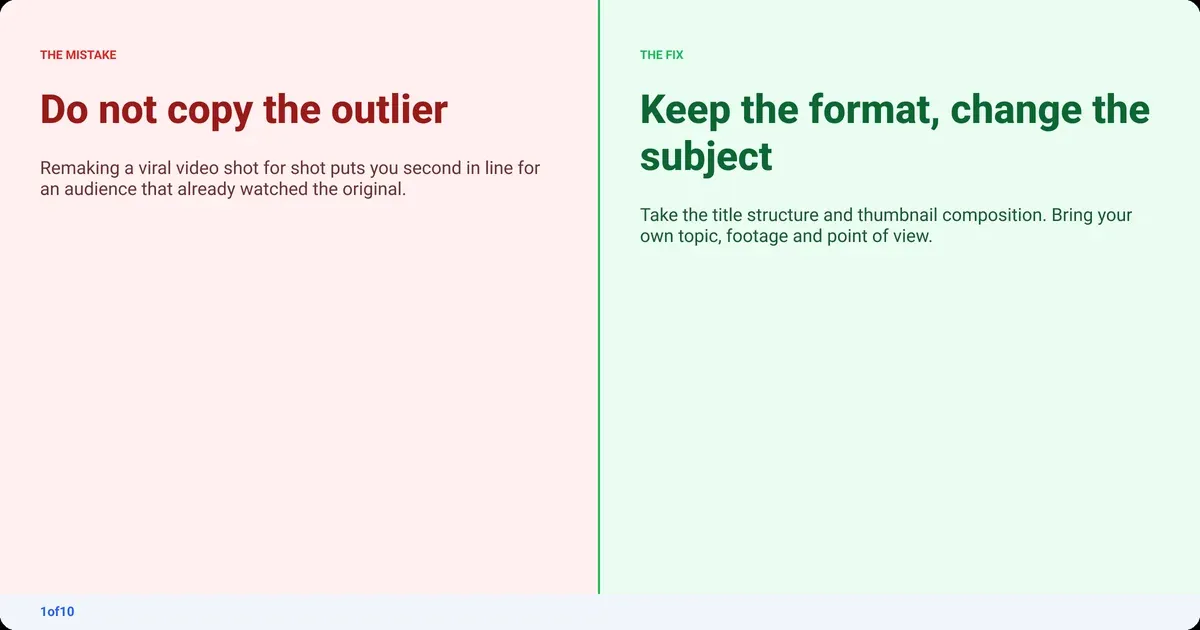
- Keep the format, change the subject. Copy the structure of the title and the composition of the thumbnail; bring your own topic, footage and take.
- Add the outlier's channel to your trackers. When they post the next spike, you see it the same day.
Outlier search never uses credits on any 1of10 plan (Free shows the top 5 results), so this step costs nothing. The guide to finding and tracking YouTube competitors covers the tracker setup.
How do you track subscriber growth on YouTube?
Track it per video, not per day. Daily counts say the channel grew; per-video counts say why. In YouTube Studio, open Analytics, go to Content, add "Subscribers" as a column and sort by it. The videos at the top are your bursts, and the gap to the rest is the outlier effect on your own channel.
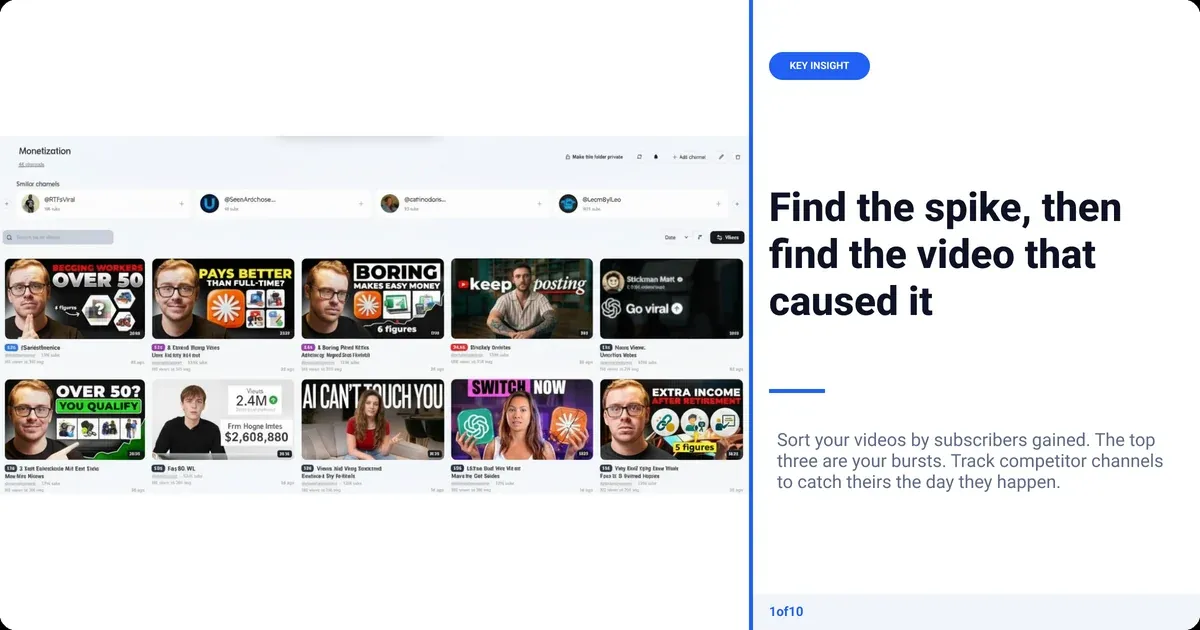
For channels you do not own, YouTube shows the public count and nothing else. A YouTube subscriber tracker fills that gap by logging a channel's count over time, so you can see when a competitor spiked and match the date to the video that caused it. 1of10's tracked channels do this on every plan, with the outlier scores on each new upload.
Three numbers worth watching every week:
- Subscribers gained per video, sorted descending.
- Subscribers per 1,000 views. Below two means reach without conversion; fix the ask and end screens first.
- Net subscribers on your spike video after 30 days. Unsubscribes after a burst mean the spike promised something the channel does not deliver.
Can you get 100 subs in a day, or 1,000?
Yes, but only as the output of a burst video. A video that reaches 50,000 people at a 2 percent subscribe rate delivers 1,000 subscribers, and that can happen inside a day when recommendation picks it up. Any method that produces the number without the video behind it fails.
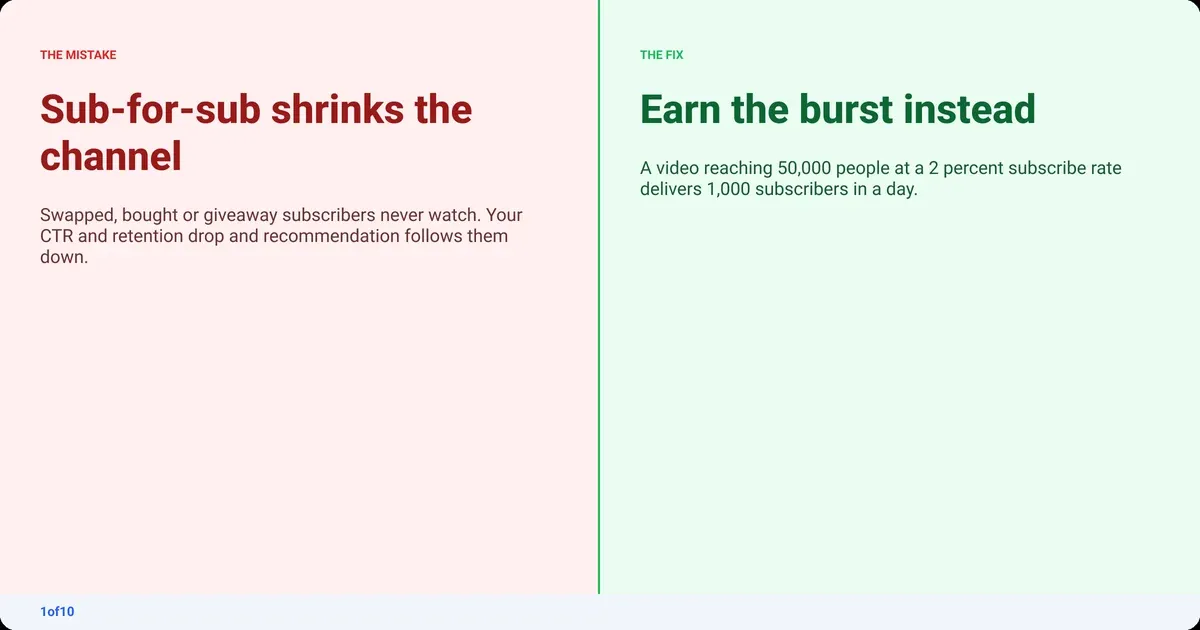
- Sub-for-sub threads, paid subscribers and "engagement pods" add accounts that never watch. Click-through rate and retention fall because impressions go to people who do not care, and recommendation follows them down. Bigger number, smaller channel. Buying subscribers also breaks YouTube's fake engagement policy.
- Giveaways that require a subscribe bring in people who wanted the prize, not the content. Same problem, slower.
- Clickbait on a trending topic spikes and then churns. If the video does not deliver on the title, the subscribers who came for it leave.
The honest answer to "100 subs in a day" is: make the video that earns it. The YouTube algorithm rewards watch time and satisfaction, and both of those come from a video people wanted.
How to get subscribers on YouTube without showing your face
Faceless channels grow on the same rules, with one difference: the trust a face builds has to come from somewhere else. Voice, editing rhythm and a consistent visual identity do that job.
- Give the channel one thumbnail style, one colour system, one title pattern, so subscribers recognise the next video in their feed.
- Use your own voice or one consistent narrator. A viewer who knows the voice follows it.
- Pick formats that do not need a presenter: screen recordings, explainers over footage, data walkthroughs.
- Run the outlier method as above. Faceless niches have their own outliers, and the formats transfer.
The ask still matters. Put it in the narration after the payoff and back it with an end screen.
Frequently asked questions
How can I get 1,000 YouTube subscribers for free?
Every method in this post is free. Pick a micro-niche with demand, find the outlier formats in it, package your video with a clear title and thumbnail, deliver the promise in the first 30 seconds, and ask for the subscribe after the payoff. Outlier search on 1of10 never uses credits, and the free plan shows the top 5 results, so the research step costs nothing either.
How many YouTube subscribers do I need to make $2,000 a month?
Subscribers do not pay; monetised views do. At an RPM of $5, $2,000 a month needs about 400,000 monetised views a month, and RPM varies by niche from under $2 to over $20. A 10,000-subscriber channel with a burst video can hit that; a 100,000-subscriber channel with dead uploads cannot. Watch views and RPM, not the subscriber count.
How do you get subs on YouTube as a beginner?
Start with research, not recording. Choose a niche where top creators earn hundreds of thousands of views, find three videos in it that beat their channel's average, and build your first upload on the shared format. Then apply the five levers: packaging, first 30 seconds, one timed ask, end screens and a playlist. Expect a flat line until the first burst.
Can you get subscribers on YouTube without making videos?
Not in any way that lasts. Community posts, comments on other channels and collaborations can bring a few subscribers, but every one of them is a bet on a video you have not made. Channels with no uploads lose those subscribers within weeks. Make one strong video and spend the outreach effort promoting it instead.
How do I get more views and subscribers on YouTube for free?
Views come from packaging and topic choice; subscribers come from what happens after the click. Use free outlier research to pick a topic with proven demand, write the title first, make a thumbnail readable at phone size, and put the payoff in the first 30 seconds. Then convert with a timed ask, an end screen and a playlist. No spend required.
Do Shorts subscribers help a long-form channel?
Yes, if the Shorts and long-form cover the same subject and the Short links to a long video worth watching. Shorts viewers subscribe at a lower rate, so treat Shorts as reach and long-form as conversion. Check the Shorts traffic source in Studio each week; if it sends views but no subscribers, fix the linked long video's packaging.