
YouTube Promotion: What Works and What Is a Scam
Most YouTube promotion services sell fake views that can get your channel terminated. Here is what actually works in 2026, plus a 7-point scam checklist.
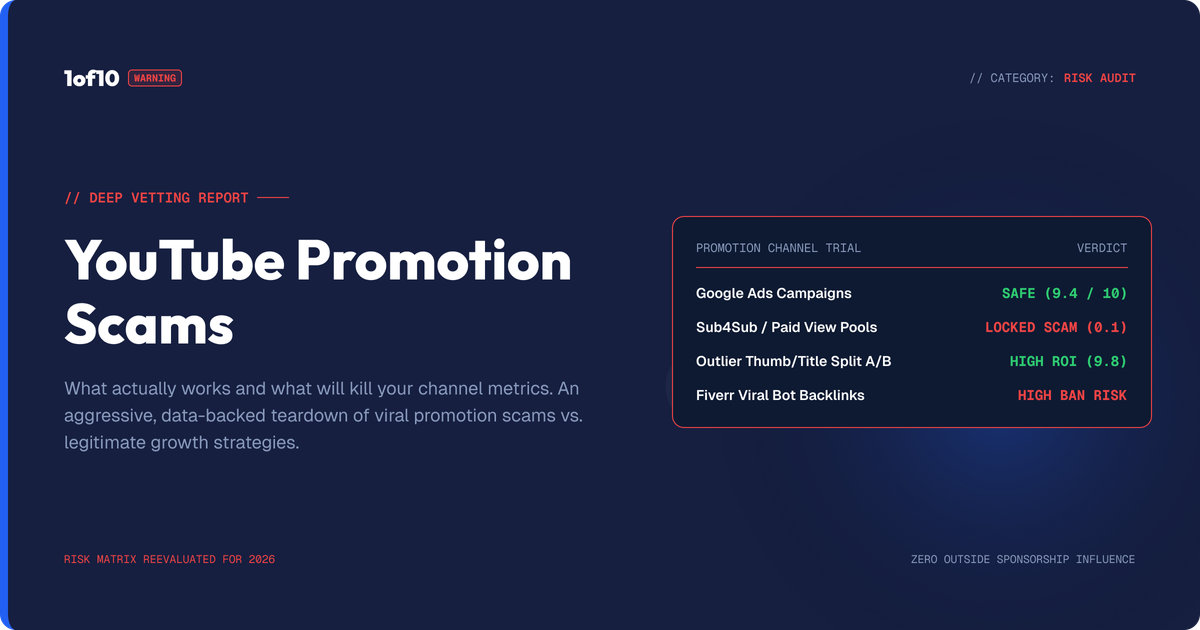
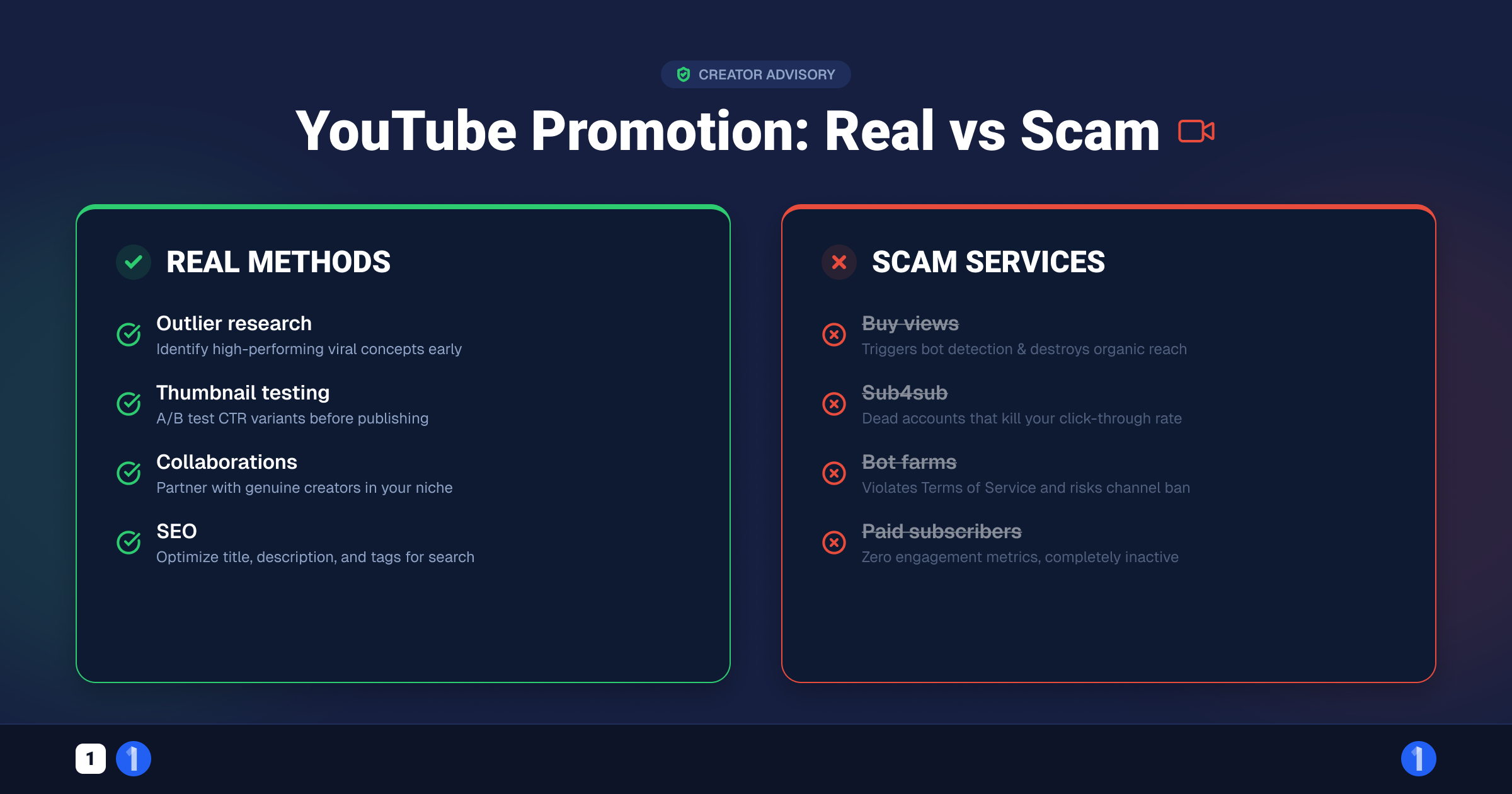
YouTube promotion means getting more people to click and watch your videos. Only three methods reliably do that: better packaging (thumbnails, titles, ideas), official YouTube ads through Google Ads, and collaborations. Everything sold as "promotion" outside those three, including view-buying services, promotion panels, and sub4sub schemes, violates YouTube's fake engagement policy and can get your channel terminated.
That is the whole game. YouTube's fake engagement policy states it plainly: the platform removes anything that "artificially increases the number of views, likes, comments, or other metrics." Three strikes within 90 days and the channel is gone. One severe case can mean immediate termination.
This guide covers what YouTube promotion actually means, the four methods that work, why the scams fail (with the mechanics, not just the warning), and a checklist for evaluating any service that promises you views.
What Does YouTube Promotion Actually Mean?
YouTube promotion is anything that increases the number of impressions your videos get and the percentage of those impressions that convert to views. That breaks into two levers: distribution (how many people see your thumbnail) and conversion (how many click it). Real promotion improves one or both. Scams fake the numbers without touching either.
Here is the part most promotion services hope you never learn: YouTube already does the distribution for free. The algorithm's job is to find audiences for videos people want to watch. As we covered in how the YouTube algorithm works, the system tests your video with small batches of viewers and scales impressions based on how those viewers respond.
So the real question is never "how do I get YouTube to show my video." It is "how do I make viewers respond well when YouTube shows it." That reframe kills 90% of the promotion industry, because most of it sells you the thing YouTube gives away.
Real promotion, then, is three jobs:
- Packaging. Thumbnails, titles, and video ideas that earn clicks when impressions arrive.
- Paid reach. Official YouTube ads through Google Ads, which buy impressions without faking engagement.
- Borrowed audiences. Collabs, Shorts, and cross-platform posting that put your channel in front of people who have never seen it.
Everything else is either a subset of those three or a scam.
What YouTube Promotion Methods Actually Work?
Four methods work: fixing your packaging with outlier research, running YouTube ads through Google Ads, collaborating with channels that share your audience, and using Shorts as a discovery engine. Each one increases real impressions or real click-through rate. None of them fakes a metric, so none of them carries a policy risk.
1. Better packaging, informed by outlier research
Packaging is the highest-ROI promotion that exists, because it multiplies every impression you already get. A video earning a 4% click-through rate instead of 2% doubles its views from the same distribution, and the algorithm responds to that improved CTR with more impressions. The gain compounds. We broke down the benchmarks in what counts as a good click-through rate on YouTube.
The fastest way to improve packaging is to study outliers: videos performing 10x to 100x above their channel's average. An outlier is proof that a specific idea, title, and thumbnail combination beat the odds. Finding enough of them in your niche reveals the patterns before you spend a cent.
The top videos in most niches run 30x to 100x their channel's average, and the very best clear 1,000x.
You can do this manually by scrubbing channel pages and comparing view counts to averages, or you can let software surface them. We compared both approaches in how to find YouTube outliers the hard way vs the fast way. The 1of10 Outlier Finder scans millions of channels and scores every video against its channel baseline, so a 47x outlier in your niche is a search away instead of a weekend away.
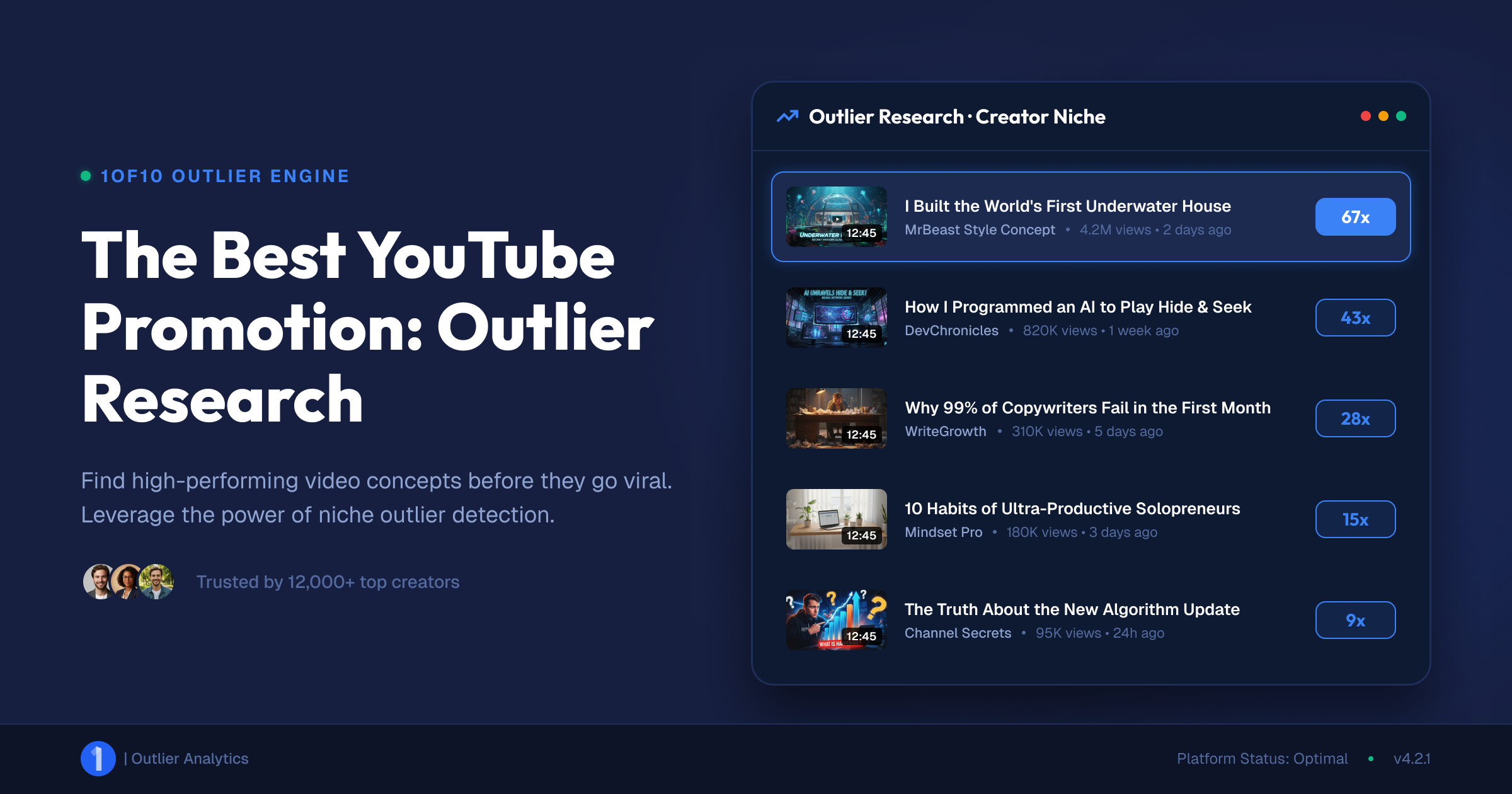
Once you know what wins, produce against it. Test thumbnail concepts before upload, iterate on the strongest one, and write titles built on proven formats. If you need volume, the 1of10 Thumbnail Generator produces variations trained on high-performing thumbnails, which beats guessing in an image editor.
2. Paid YouTube promotion through Google Ads
Paid YouTube promotion is legitimate when it runs through the official channel: Google Ads video campaigns, including the Promotions tab inside YouTube Studio. Views from ads count, comply with policy, and can seed a new video with real viewers. YouTube documents the formats in its video campaign guide.
Three things to know before spending:
- Ads buy impressions, not fans. A skippable in-stream view is a weaker signal than an organic browse click. Ads work best for channels with proven packaging, promoting a video that already converts well organically.
- In-feed formats beat in-stream for growth. In-feed ads put your thumbnail in search and browse results, so the viewer chooses to click. That is much closer to organic behavior.
- Costs are real. In-feed video ad clicks in competitive niches commonly run between $0.10 and $0.30 per view, and converting an ad viewer into a subscriber takes multiples of that. Budget for a test, measure returning viewers, and kill campaigns that only buy vanity numbers.
We went deeper on when paying makes sense in should you pay to promote your YouTube videos. Short version: ads amplify what already works. They cannot fix packaging that does not convert, because you end up paying for impressions that die at the thumbnail.
3. Collaborations
A collab is an audience transfer between channels with overlapping viewers. It works because the recommendation comes from a trusted source, which no ad can replicate. Guest appearances, shared videos, shout-out trades, and community post mentions all count.
The practical playbook:
- List 20 channels within roughly 0.5x to 3x your size in your niche.
- Watch their content and find a genuine crossover idea. Pitch the idea, not yourself.
- Structure the collab so both audiences get a reason to cross over: a two-part video, a shared challenge, a guest slot each.
- Link each other's videos in pinned comments and end screens, not just descriptions.
Channels close to your size reply more often and convert better, because their audience sees you as a peer discovery rather than a sponsored plug.
4. Shorts as a discovery engine
Shorts reach viewers who have never seen your channel, at zero cost, with the highest impression volume YouTube offers. The catch is conversion: Shorts viewers subscribe at lower rates than long-form viewers, so treat Shorts as top-of-funnel promotion, not a growth strategy on their own.
The move that works: cut your best long-form moments into Shorts that create an open loop the full video closes, then link the video. We covered the mechanics in how to use YouTube Shorts to grow your channel.
Why Are Most YouTube Promotion Services a Scam?
Most paid promotion services deliver views from bots, click farms, or unrelated audiences. Those views watch for seconds, engage with nothing, and tell YouTube's algorithm that your video repels people. The result is worse distribution, not better, plus direct exposure to YouTube's fake engagement policy, which removes fake metrics and can terminate channels after three strikes in 90 days.
That is the summary. Here is the mechanism, because understanding it is what protects you from the next cleverly worded offer.
The retention signal problem
YouTube measures what happens after the click: watch duration, retention curve, likes, comments, whether the viewer watches another video. These signals decide how widely a video gets recommended.
Bought views produce catastrophic signals. A bot watches 3 seconds. A click-farm worker watches 30 seconds of a video in a language they do not speak. Either way, your retention graph collapses and your engagement rate per view drops toward zero.
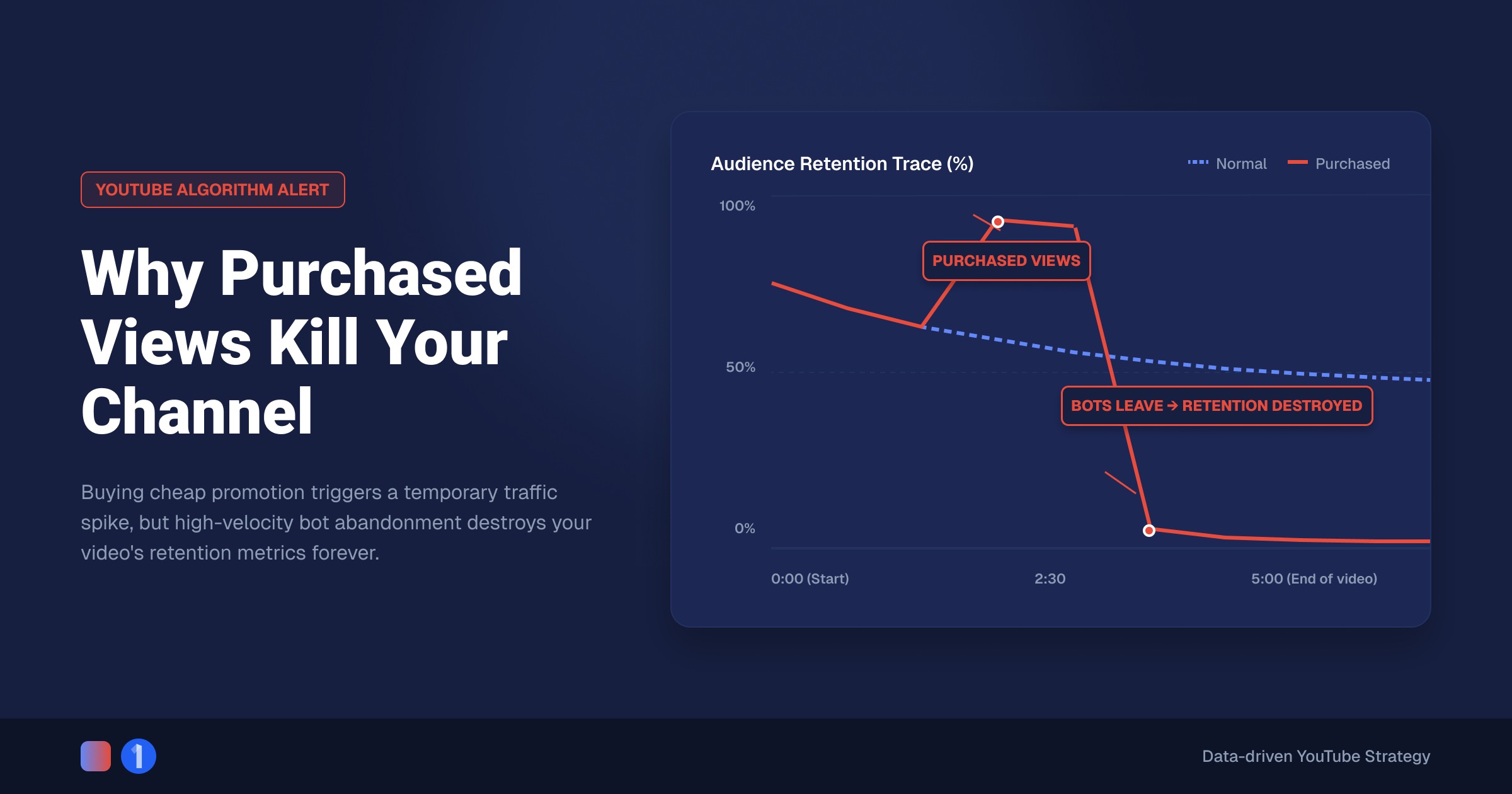
Now the algorithm does math on you. Before the bought views, your video held viewers for 45% of its length. After 10,000 junk views, average retention reads 8%. YouTube's test batches conclude the video is a dud and impressions dry up, including for the real audience who would have loved it. You paid to teach the algorithm your content is bad.
The policy problem
Even if the signals could be hidden (they cannot), the policy risk stands alone. YouTube's fake engagement policy prohibits:
- Purchasing views, likes, comments, or subscribers from third-party services
- Links to view-gaming or subscriber-boosting sites, anywhere in your metadata
- Sub4sub arrangements, meaning "subscribe to me and I will subscribe to you"
- Serving videos to unsuspecting viewers through automated systems
Enforcement escalates fast. First violation: a warning. Three strikes within 90 days: channel terminated. Severe or dedicated abuse: immediate termination, no strike ladder. And YouTube closes the outsourcing loophole explicitly, stating that "any method that violates our policies may result in content removal or a channel takedown, whether it's an action taken by you or someone you've hired." Hiring the scam does not shield you from the scam.
Fake subscribers carry a bonus penalty: they count toward nothing. YouTube removes fake metrics from totals, and the monetization review checks channels for artificial engagement before admitting them to the Partner Program. Channels have been rejected or removed from monetization over purchased engagement they bought years earlier.
The three most common scam formats
| Scam format | The pitch | What actually happens |
|---|---|---|
| View-buying services | "10,000 real views for $50" | Bot or click-farm traffic, retention collapse, policy violation, views often purged within weeks |
| Promotion panels / SMM panels | "Organic promotion across our network" | Reseller dashboards for the same bot traffic, one layer removed so it sounds legitimate |
| Sub4sub groups | "Free! Just support each other" | Dead subscribers who never watch, which suppresses your impressions-per-subscriber signal, and a named policy violation |
The panel version deserves a flag because it is dressed best. "Promotion panels" and "SMM panels" market themselves with words like organic, network, and real users. They are storefronts reselling bot traffic at a markup. If a service cannot tell you the specific placement your views come from (which ad format, which platform, which audience), it is a panel.
What about "guaranteed" press, playlist, and influencer placements?
A gray zone exists: services promising placement in "high-traffic playlists," embedded video networks, or influencer shout-out marketplaces. Some are real but low-value (views from autoplay embeds retain terribly). Some are repackaged bot traffic. The evaluation checklist below sorts them, but the default assumption should be no.
How Do You Evaluate Any YouTube Promotion Service?
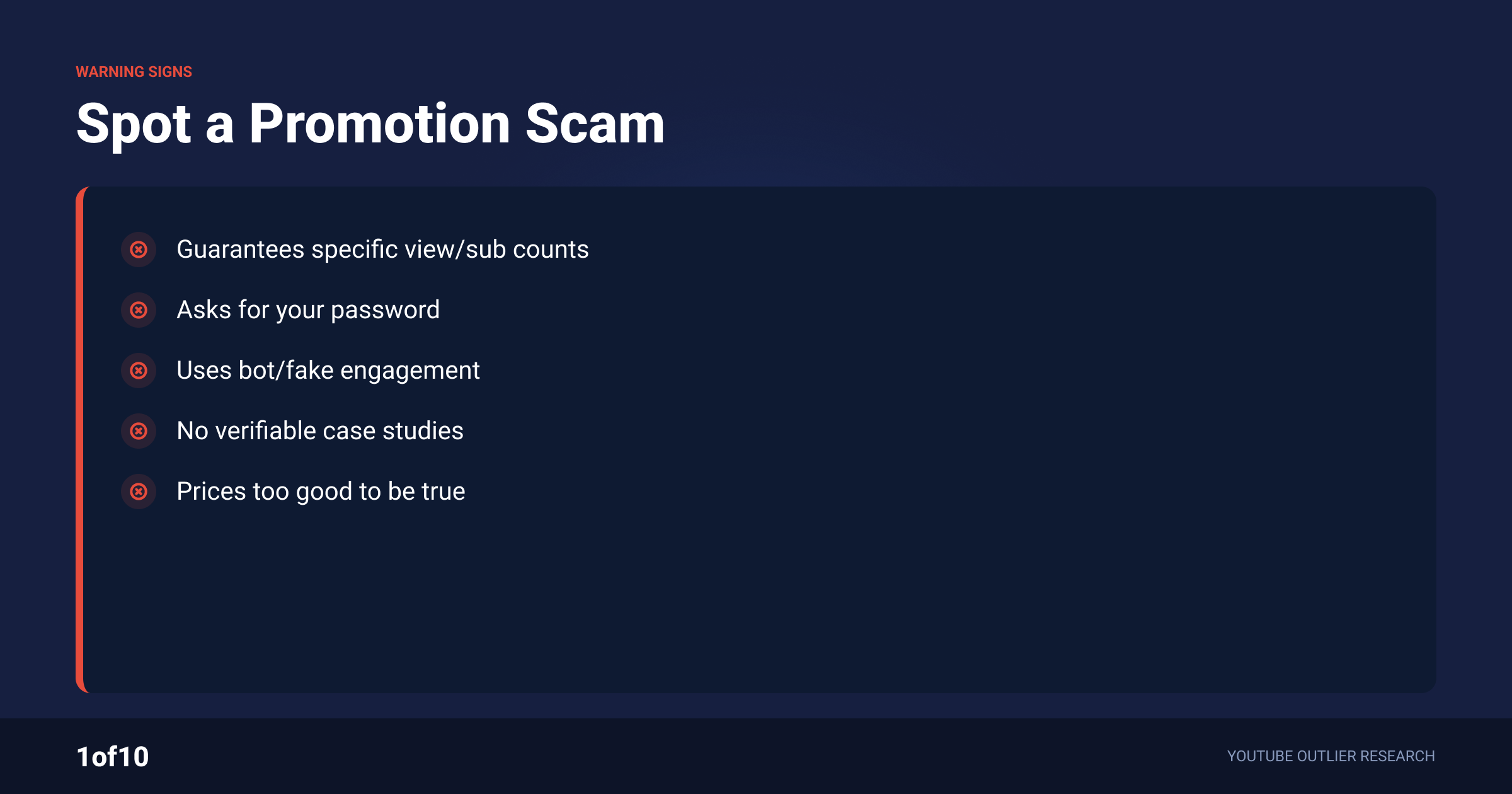
Run every offer through seven questions. A legitimate service passes all seven. Scams usually fail three or more within the first minute of reading the sales page.
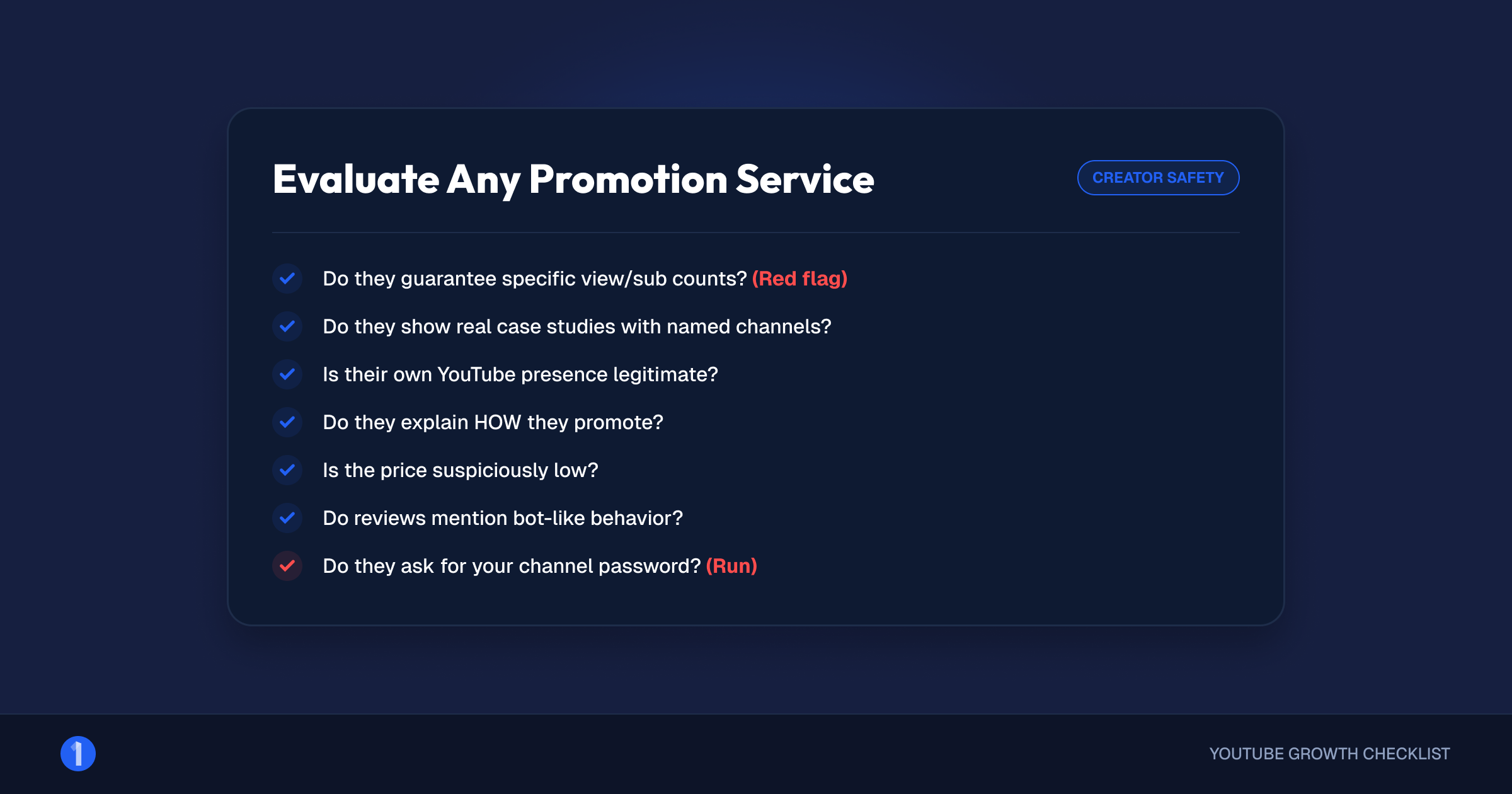
- Does it promise a specific number of views or subscribers? Real advertising buys impressions and estimates outcomes. Guaranteed view counts require faking them. Instant fail.
- Can they name the exact traffic source? "Google Ads in-feed campaigns targeting these audiences" is an answer. "Our promotion network" is not.
- Do they need your channel access or just your video URL? Nobody legitimate needs your password. Services that ask are adding account theft to the menu.
- Is the price plausible? Real ad-driven views cost real money. 10,000 views for $50 means $0.005 per view, roughly 20x to 60x below what genuine in-feed ad inventory costs. The gap is filled with bots.
- Do they mention retention, CTR, or audience match anywhere? Legitimate promotion lives and dies on these. Scam pages never mention them because their product destroys them.
- Would you be comfortable showing the receipt to YouTube? Google Ads invoices, collab agreements, and sponsorship contracts all survive that test. SMM panel receipts do not.
- Does the testimonial page show channels you can visit? Check two or three. Dead channels, comment sections full of spam, or channels with 50K subscribers and 200 views per video are the tell.
Print this, or bookmark it. The scam industry iterates on wording every year, but no view-selling business has ever passed question 4, because the economics are impossible without fraud.
What Is the Organic YouTube Promotion Playbook?
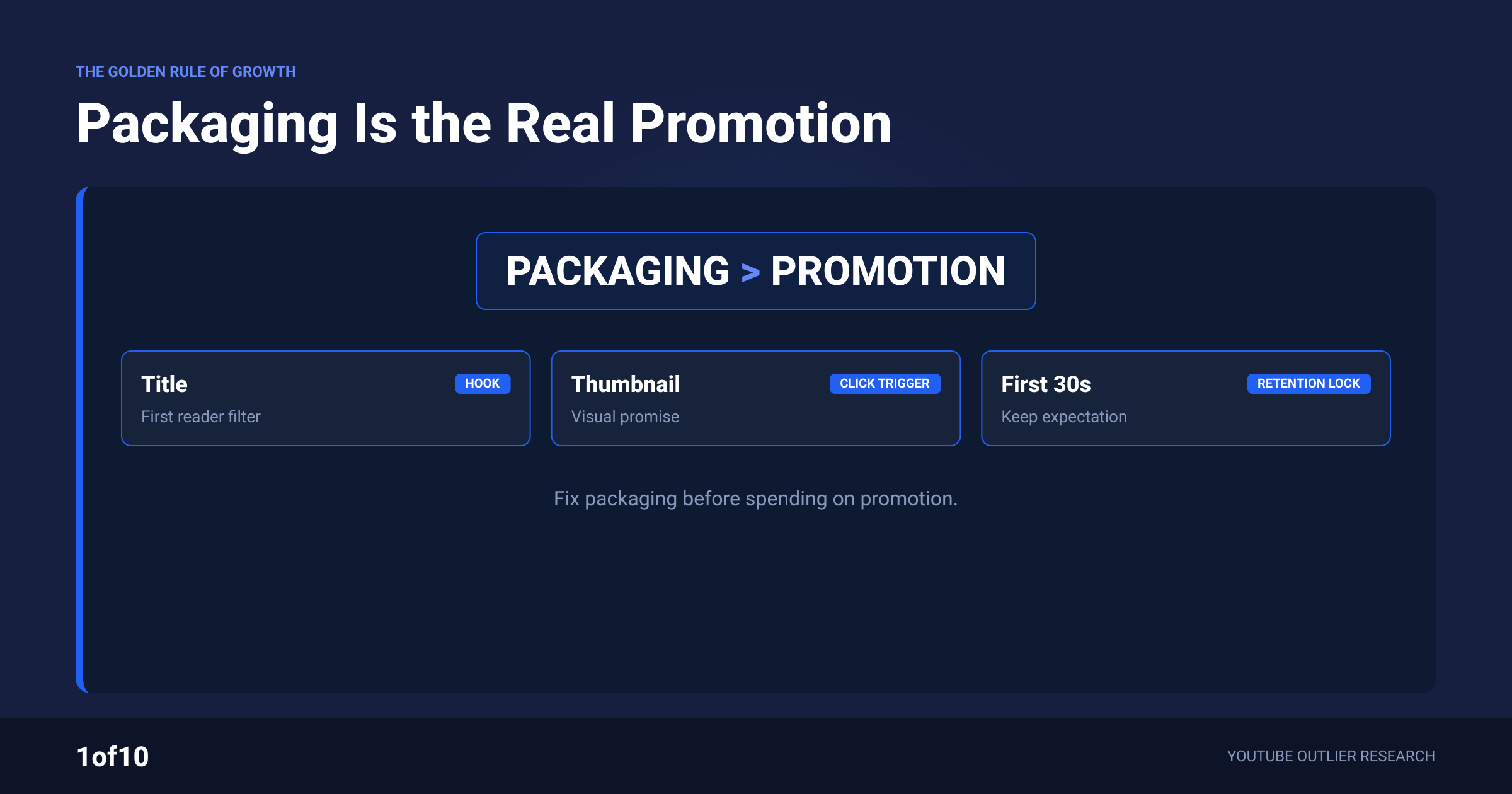
The organic playbook is five steps: research outliers in your niche, package the video before you make it, optimize the metadata basics, promote in the first 48 hours through owned and borrowed channels, then iterate on the packaging of anything underperforming. It costs time instead of money, and it compounds instead of evaporating.
Here is each step, in the order that matters:
- Research before you film. Pull the top outliers in your niche from the last 90 days. Look for repeated formats, title structures, and thumbnail patterns. Pick ideas where you can add something the outlier missed. In most niches, one repeatable format shows up again and again across the top outliers.
- Package first, produce second. Write the title and rough the thumbnail before scripting. If the packaging is not clickable, the video does not deserve production time yet. Test concepts against each other, and use proven CTR tactics rather than instinct.
- Cover the metadata basics once. Accurate title, honest description with links, correct chapters, a handful of relevant tags. This is 30 minutes of hygiene, not an ongoing promotion channel.
- Work the first 48 hours. Post to your community tab, reply to every early comment, cut one or two Shorts from the video, share to whatever off-platform audience you have (newsletter, Discord, other socials). Early engaged viewers give the algorithm its first positive test batch.
- Iterate on the misses. A video with strong retention but weak views has a packaging problem. Swap the thumbnail and retitle it. Packaging changes on old videos are free promotion, and they work: a title and thumbnail swap re-triggers algorithmic testing on content you already paid to make.
Repeat weekly. Nothing on this list can be bought for $50, which is exactly why it works.
What Is the Best YouTube Promotion for Long-Term Growth?
The best YouTube promotion is better packaging, full stop. Distribution is free and algorithmic. Views can be bought but poison your signals. Packaging is the one lever that improves every impression you will ever receive, on every video, permanently. Creators who out-package their niche get promoted by YouTube itself, which is the only promotion service with unlimited inventory.
That is the honest product pitch too. 1of10 exists because packaging research was the bottleneck: finding what wins in a niche used to take hours of manual channel-scrubbing. The Outlier Finder compresses that into minutes, the Chrome extension shows outlier scores directly inside YouTube for free, and the AI generators turn the research into testable thumbnails and titles.
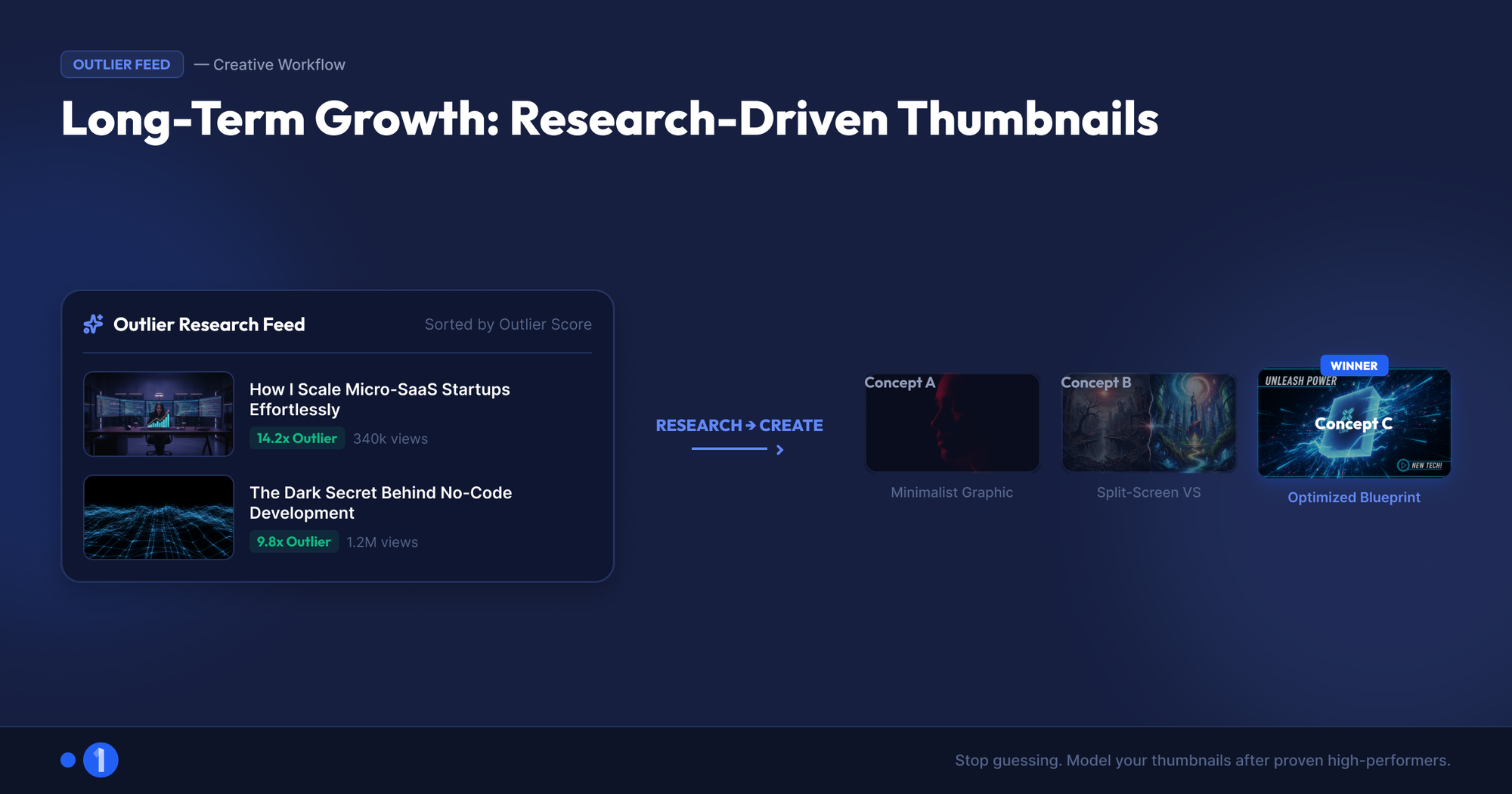
Spend your promotion budget on research and packaging tools, or spend it on Google Ads once your packaging converts. Those are the only two line items that survive contact with the algorithm.
FAQ
Is paid YouTube promotion legit?
Yes, through exactly one channel: Google Ads video campaigns, including YouTube Studio's built-in Promotions tab. Those views comply with YouTube policy and come from real ad placements. Any paid promotion outside Google Ads that guarantees view counts is selling artificial engagement, which violates the fake engagement policy and risks channel termination.
Can buying YouTube views get my channel banned?
Yes. YouTube's fake engagement policy prohibits purchased views, likes, comments, and subscribers. Enforcement starts with a warning, escalates to strikes, and three strikes within 90 days terminates the channel. Severe cases skip the ladder entirely. YouTube also states that violations committed by someone you hired still count against you.
Does sub4sub work on YouTube?
No, and it is explicitly against policy. Sub4sub subscribers never watch your videos, which drags down your views-per-subscriber and impressions signals, so the algorithm shows your uploads to fewer people. YouTube names sub4sub in its fake engagement policy as a prohibited scheme, so it damages your channel twice: algorithmically and legally.
How much does real YouTube promotion cost?
Organic promotion costs time: research, packaging, and first-48-hour effort. Paid promotion through Google Ads typically runs $0.10 to $0.30 per in-feed view in competitive niches, so a meaningful test starts around $200 to $500. Any service quoting a fraction of a cent per view is delivering bots, because legitimate inventory cannot exist at that price.
What is the fastest way to promote a YouTube video?
Fix its packaging. A thumbnail and title swap on an underperforming video re-triggers algorithmic testing within days and costs nothing. Research outliers in your niche to see what earns clicks, rebuild the packaging against that evidence, then support the video with Shorts and community posts during the following week.
Ready to promote the only way that compounds? Start with free outlier research: install the 1of10 Chrome extension and see outlier scores on every video you browse, or search your niche in the Outlier Finder.