How to Find Viral YouTube Videos Before Everyone Else (2026)
There are two types of YouTube creators. The first kind watches a video blow up, scrambles to make something similar, uploads it three weeks later, and wonders why it gets 400 views. The second kind already filmed that topic two weeks before the first version went viral.
The difference between them is not talent, equipment, or editing skill. It is the data they look at before they hit record.
This guide breaks down the method the second type of creator uses to consistently get ahead of trends, and why most of the conventional advice about finding viral ideas points you in exactly the wrong direction.
Why Most Creators Are Always Three Weeks Late
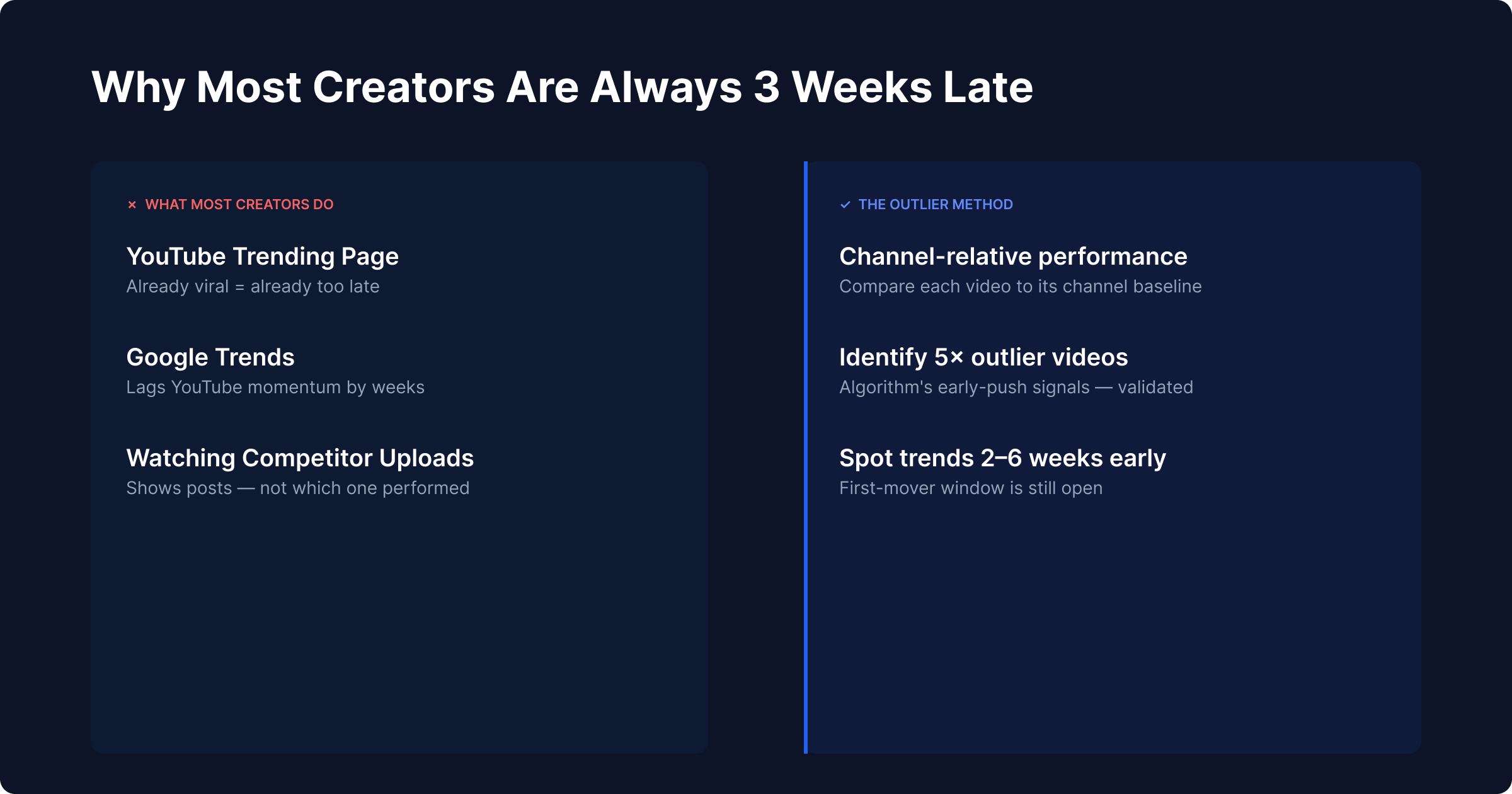
The instinct most creators follow is logical: find what is trending, make a version of it, ride the wave. The problem is that by the time something is trending, the wave has already broken.
When a topic is showing up on YouTube's trending page or spiking on Google Trends, it means thousands of other creators have already noticed the same signal. The algorithm has already started pushing existing videos on that topic to millions of viewers. The creators who got there first are already collecting those views.
You are not finding a trend. You are finding the aftermath of one.
The same problem applies to watching what competitors are doing. If a creator in your niche posts a video that gets 500,000 views and you decide to make a similar one, you are operating on a delay. The audience appetite for that specific topic has already been partially satisfied. The algorithm has already found its preferred videos to recommend on that subject.
Copying trends reactively almost always fails, and the math explains why: by the time a topic becomes visibly trending, the algorithmic distribution advantage that made the first videos successful is already allocated to those videos.
What You Should Be Looking At Instead
The signal that actually predicts what is coming is not what is trending today. It is what is overperforming right now relative to expectations.
This is the concept of the outlier video.
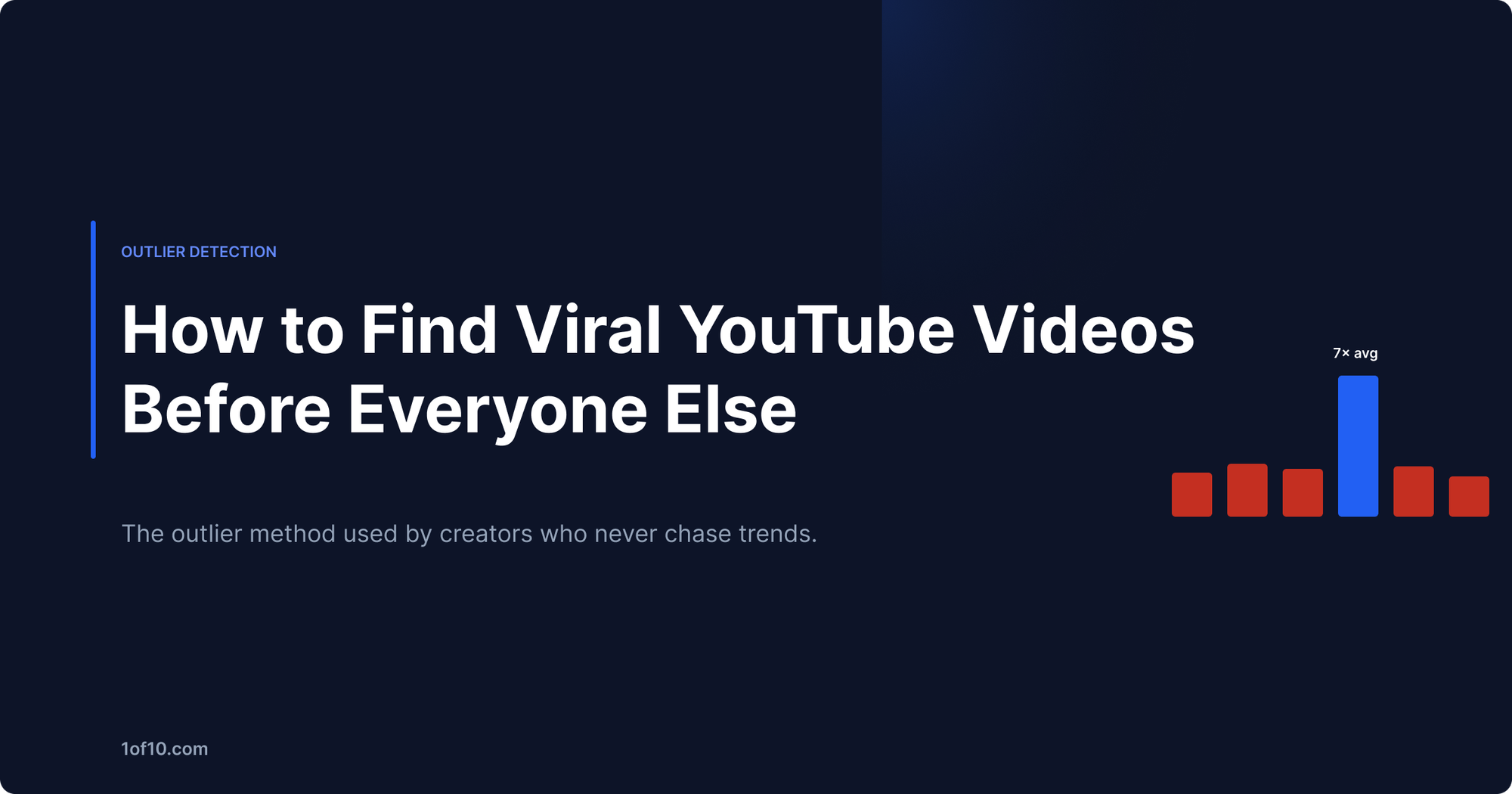
An outlier video is not a viral video in the conventional sense. It is a video performing significantly above its own channel's average. A channel that normally gets 10,000 views per video suddenly has one sitting at 80,000. A creator who averages 500 views has a video with 6,000. That disproportionate performance relative to the channel's baseline is the outlier signal.
Why does this matter? Because the YouTube algorithm reads it as a quality signal and starts pushing the video beyond the creator's existing subscriber base. When that happens, it validates the topic in the algorithm's eyes. More creators make content on that topic. The topic builds momentum. Two to four weeks later, it looks like a trend.
The creators who found the outlier video early are already there. Everyone else is still trying to catch up.
If you want to understand how the YouTube algorithm works, this outlier signal is at the core of how content gets pushed beyond its existing audience.
The Three Wrong Ways Most Creators Research Video Ideas
Before explaining the method that works, it is worth being specific about what does not.
YouTube's trending page. This shows you what is already winning. The algorithm has already decided those videos are worth pushing. Making a new video on the same topic puts you in a crowded queue competing with content that has weeks of engagement signals on you.
Google Trends. Useful for evergreen topic research but not for predicting YouTube momentum. By the time a topic is spiking enough on Google Trends to notice, the early-mover advantage on YouTube is gone. YouTube and Google search behave differently, and Google Trends data significantly lags YouTube algorithmic momentum.
Watching what competitors are posting. The problem is the same one. You are looking at what your competitors already decided to make, not at what the audience is already responding to. The difference matters enormously. A competitor might post ten videos. Nine get average performance. One breaks out. That one is the outlier. Watching their uploads shows you all ten equally. Watching their performance data shows you which one matters.
Using tracked channels gives you this performance view across your entire competitive set automatically, so you see the outlier signal without manually checking each channel.
How Outlier Detection Actually Works
Finding outlier videos manually is possible, but it is slow.
The process looks like this: pick a channel in your niche, sort their videos by view count, compare the top-performing video to the channel's average. If the top video has five times the views of their typical content, that is an outlier worth investigating. Look at the title, the topic, the format. Note when it was published. Check if other channels have made similar content. If they have not yet, you have found a window.
Do that for ten channels in your niche and you start to see patterns. Certain topics, formats, or angles are consistently outperforming baseline across multiple creators. That convergence is the strongest signal available that a topic has algorithmic momentum.
The problem is doing this manually takes two to four hours per research session, you can only look at one channel at a time, and you need to do it at least weekly to stay ahead of the curve.
1of10 automates this entire process. It scans channels across your niche, identifies videos that are outperforming their channel average, and surfaces the patterns. Instead of spending hours in spreadsheets comparing view counts, you get the outlier signal directly. You can see which topics are overperforming in your niche right now, not after they have already peaked.
The homepage outliers feature specifically surfaces videos that the YouTube algorithm is already pushing to the homepage feed — the clearest early signal of what is building momentum.
Try it free at 1of10.com — no credit card needed.
How to Use Outlier Data to Choose Your Next Video Topic
Finding an outlier is the research step. Turning it into a video that performs is the creative step. Here is how the workflow connects.
Step 1: Identify the pattern, not just the topic. When you find an outlier video with 5x normal performance, look past the surface topic. A video called "I tried every AI thumbnail tool for 30 days" is not just about AI thumbnail tools. The pattern is: long-form personal experiment with a specific timeframe. The topic is AI tools. The format is the test. Both matter.
Step 2: Find the angle that is not yet covered. If one creator has an outlier on a topic, look at what angle they took. Then find the angle they did not take. The adjacent territory is less competitive and still benefits from the same audience appetite the original outlier created.
Step 3: Validate across multiple channels. One outlier on one channel might be luck or an existing audience relationship. Two or three outliers on the same topic across different channels is a signal the algorithm is genuinely favouring that content right now. That is when you act.
Step 4: Move within the window. Outlier momentum typically runs for two to six weeks before the topic becomes saturated. You do not need to be the very first creator. You need to be in the first wave, not the third.
Once you have your topic locked, a strong AI YouTube title generator helps you turn that validated idea into a title that drives clicks before you even film. Pair that with thumbnail fonts proven to lift CTR and you have the full packaging stack before filming starts.
Real Examples of How Outlier Videos Predicted Trends
This method is not theoretical. It is how specific content categories on YouTube have developed, repeatedly.
AI tools content in 2023. Before ChatGPT-related YouTube content was widely considered a category, individual creators in tech and productivity niches were getting outlier performance on AI workflow videos. Their channel averages did not predict it. The outlier signal did. The creators who caught those early outliers built entire channels around the category before the algorithm was pushing it to everyone.
Faceless YouTube channel tutorials in 2024. Videos on building YouTube automation channels were outperforming their creators' baselines by 4–6x for months before the topic showed up in any trend report. Creators who found those early outliers built audiences in the category. Everyone who waited for the trend report arrived to find it already saturated.
YouTube Shorts strategy content in late 2024. As YouTube shifted recommendation weight toward Shorts, a cluster of creators started getting outlier performance on Shorts-specific strategy videos. You can track which Shorts formats are generating shorts outliers in your niche the same way you would for long-form.
Building a Content Calendar From Outlier Signals
Once you have a regular outlier research process, your content calendar stops being a creative problem and becomes a prioritisation problem.
A weekly outlier scan across ten to fifteen channels in your niche gives you a ranked list of topics with validated algorithmic momentum. You pick the ones with the strongest signal and the least existing competition, find the angles not yet covered, and build your calendar from that.
This approach has a compounding effect. As you publish content on topics with existing outlier momentum, your own videos start benefiting from the same algorithmic tailwind that pushed the original outliers. Your content does not need to go viral on its own. It needs to enter a category the algorithm is already favouring.
The creators who do this consistently do not have unpredictable performance. They have a process. If you want a deeper breakdown of what makes a video go viral, the analysis of what actually makes a YouTube video go viral in 2025 remains one of the most referenced pieces on the topic.
Common Questions About Finding Viral YouTube Videos
How far in advance can outlier data predict trends?
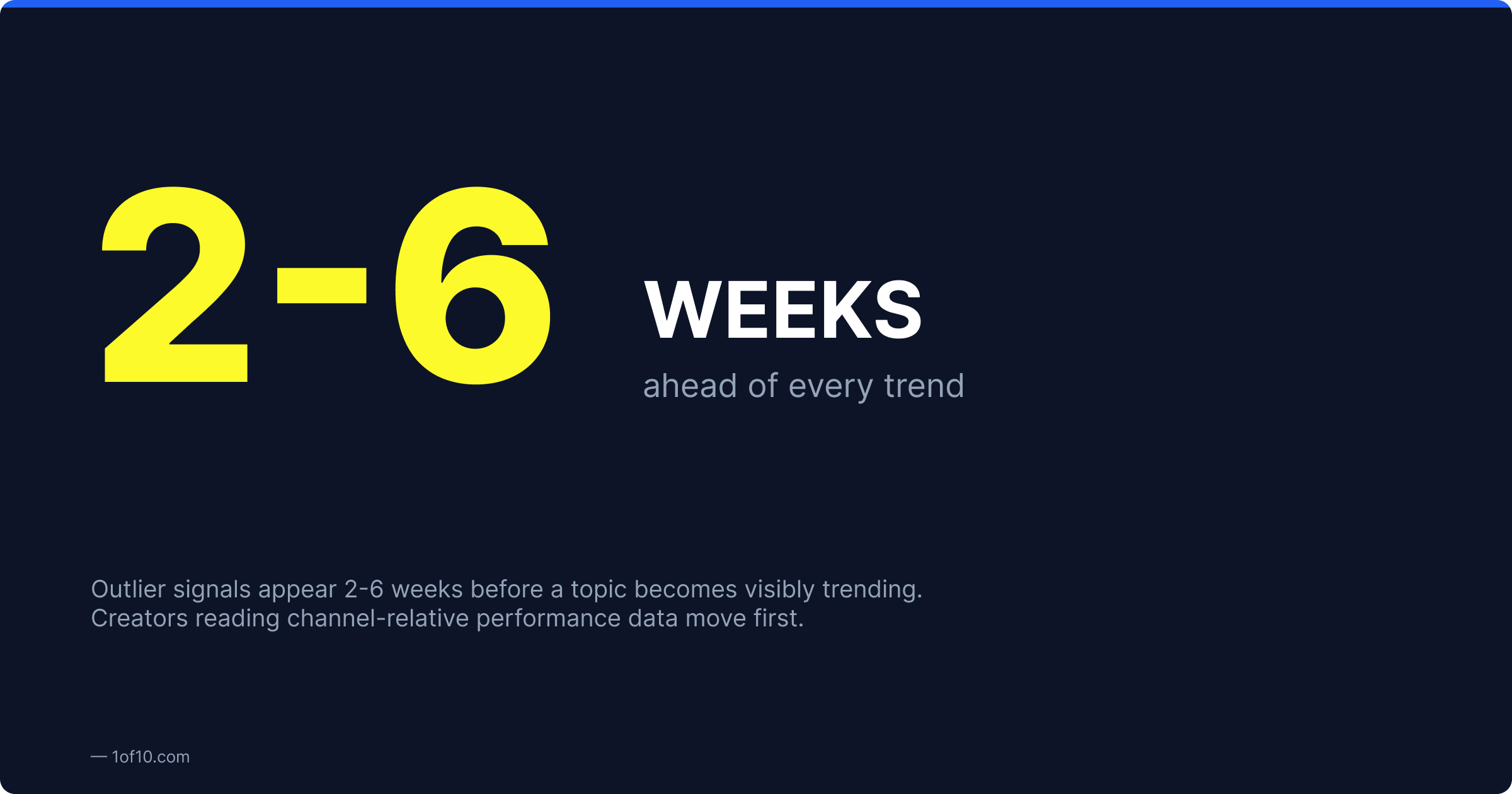
Typically two to six weeks. The outlier signal appears when a video starts overperforming on a relatively small distribution. By the time that builds into a visible trend, the early window has passed. Using outlier data gives you the two-to-six week head start before the topic becomes publicly obvious.
Does this work for small channels?
Yes, and it is actually more valuable for small channels. Large channels with established audiences can make content on almost any topic and get decent performance from their existing subscriber base. Small channels are almost entirely dependent on the algorithm pushing their content to new viewers. That means picking topics the algorithm is already favourable toward matters much more. How to grow a YouTube channel from a small base depends almost entirely on this topic selection discipline.
What counts as a meaningful outlier?
As a rough benchmark, a video performing at 3x or more of its channel's average over the same publication window is worth noting. A video at 5x or above is a strong signal. The threshold matters less than the pattern: multiple videos on similar topics outperforming baseline across different channels is the signal you are looking for. The advanced filters in 1of10 let you set these thresholds precisely.
Does the outlier method work for Shorts?
Yes. Shorts have their own algorithmic recommendation engine (decoupled from long-form since mid-2026), and the same outlier logic applies. A Short performing well above a creator's typical Short view count indicates the algorithm is pushing that format or topic in the short-form feed.
How often should I run outlier research?
Weekly is the minimum to stay ahead of trends rather than chasing them. The window between outlier signal and full trend saturation is two to six weeks. Missing a week means you might find a trend just as it tips from early-mover to crowded.
Can I find outliers in any niche?
Any niche with active channels producing regular content generates outlier signals. The niche explorer makes it straightforward to survey multiple potential niches before committing to one.
The Practical Summary
Finding viral YouTube videos before everyone else is not about being lucky or having better instincts. It is about looking at a different data point than most creators look at.
Channel-relative performance, not absolute view counts or platform trends, is the signal that predicts what the algorithm is about to push. Finding that signal early, understanding the pattern behind it, and moving within the window is the repeatable process that separates creators who consistently hit with their content from those who are always catching up.
The manual version of this process works. It just takes several hours per week. The automated version through 1of10 surfaces the same outlier signals across your entire niche without the manual research grind. Free trial, no card required, takes about two minutes to set up.