
YouTube Monetization in 2025: The Complete Guide
For creators, there is nothing more exciting than the moment your channel qualifies for monetization. Suddenly, your videos are not just a passion project, they become an income stream. For some, this is side money. For others, it’s the start of a career that can rival or even surpass a traditional job.
In 2025, YouTube continues to dominate the creator economy because of its superior payout system, multiple revenue streams, and long content lifespan. Unlike TikTok or Instagram, where a post might earn money for a few days before disappearing, YouTube videos keep earning for years. A single video can bring in ad revenue, sell products, and attract sponsorships long after it’s uploaded.
This guide will break down how YouTube monetization works today, how much you can realistically make, and what strategies you can use to maximize income. We’ll also compare YouTube to other platforms so you understand why it remains the best place to monetize your content.
1. How YouTube Monetization Works
At its core, YouTube monetization is the process of earning money from your content through ads and additional features. The foundation of this system is the YouTube Partner Program (YPP), which unlocks monetization tools once you meet the requirements.
1.1 The YouTube Partner Program (YPP)
To join YPP in 2025, you need to hit one of these milestones:
- 1,000 subscribers and 4,000 public watch hours in the last 12 months.
- OR 1,000 subscribers and 10 million valid Shorts views in the last 90 days.
You must also follow YouTube’s monetization policies, which means no reused content without commentary, no harmful material, and compliance with copyright rules.
Once accepted, YouTube will display ads on your videos. Revenue is split: 55% goes to you, 45% to YouTube. For Shorts, creators earn from a shared pool funded by ad revenue.
1.2 Types of Ads
Not all ads are equal. YouTube offers several formats, and the mix you get affects your revenue:
- Display ads: Shown alongside your video.
- Overlay ads: Semi-transparent banners that appear on desktop.
- Skippable video ads: The most common, viewers can skip after 5 seconds.
- Non-skippable ads: Must be watched before the video starts.
- Bumper ads: Six-second ads that can’t be skipped.
Advertisers pay different rates for each format, and YouTube decides which ones run on your video based on your niche, audience, and advertiser demand.
1.3 CPM and RPM
Two key metrics determine how much you earn:
- CPM (Cost Per Mille): What advertisers pay YouTube per 1,000 ad views.
- RPM (Revenue Per Mille): What you actually earn per 1,000 video views after YouTube’s cut.
If your CPM is $10, your RPM might be closer to $5–$6, depending on factors like geography and watch time.
1.4 Monetization Beyond Ads
Ads are just the entry point. Once you’re in YPP, you unlock memberships, Super Chats, Super Stickers, and YouTube Premium revenue. These can often rival or even surpass ad income, especially for creators with highly engaged audiences.
2. How Much Money Do YouTubers Make?
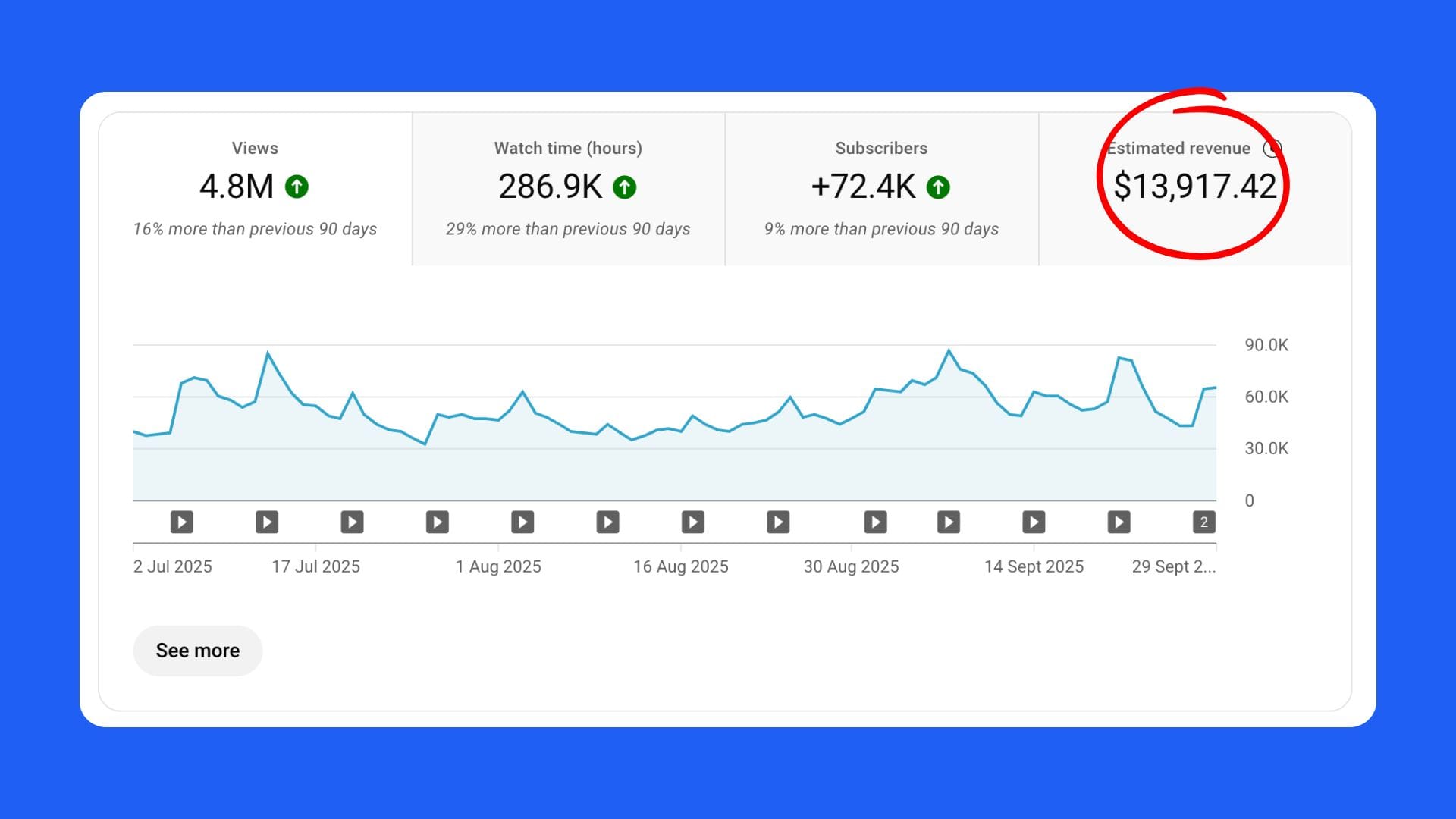
The short answer is: it depends. The long answer is that earnings are influenced by your niche, your audience’s location, the type of ads you attract, and your ability to diversify revenue streams.
2.1 Average CPM by Niche
Some niches pay dramatically more than others. Here’s a look at CPM ranges in 2025:
| Niche | CPM Range (per 1000 views) | Why It Pays Well |
|---|---|---|
| Personal Finance | $10–$20 | Banks, fintech, and investment firms spend heavily on ads. |
| Tech Reviews | $7–$15 | High competition for new product launches. |
| Education | $8–$12 | Stable demand, especially for skills and tutorials. |
| Health & Fitness | $5–$10 | Strong mix of ads + sponsorships from fitness brands. |
| Gaming | $2–$6 | Lower CPMs, but high audience volume + strong sponsorship potential. |
| Lifestyle & Vlogs | $2–$5 | Broad appeal, monetizes better with merch and affiliates. |
2.2 Example Earnings by View Count
Let’s put this into perspective. Below is a rough estimate of what creators in different niches might earn at different view counts:
| Views | Finance Channel ($12 CPM) | Tech Channel ($9 CPM) | Gaming Channel ($4 CPM) |
|---|---|---|---|
| 100,000 | $1,200 | $900 | $400 |
| 1,000,000 | $12,000 | $9,000 | $4,000 |
| 10,000,000 | $120,000 | $90,000 | $40,000 |
This shows why niche choice matters so much. A finance creator can make 3x more from the same number of views than a gaming creator.
2.3 Location Matters
Advertisers also pay more for certain audiences. A viewer in the U.S., U.K., Canada, or Australia is worth more than one in countries with lower ad spend. This is why two creators with the same view count can earn completely different amounts.
2.4 Beyond Ad Revenue
Ad revenue is only part of the equation. Sponsorships, affiliates, and digital products can far exceed what you earn from ads. For example:
- A gaming channel with 1M views might make $4,000 in ad revenue but land a $15,000 sponsorship with a gaming chair brand.
- A finance creator might earn $12,000 from ads but an additional $20,000+ from affiliate deals with trading platforms.
3. Revenue Streams Available to YouTubers
YouTube is unique because it doesn’t lock you into one way of earning. Once your channel grows, you can stack multiple revenue streams to create reliable and diversified income. Some creators earn most of their money from ads, while others earn far more from sponsorships or their own products. Let’s break down the key options.
3.1 Ad Revenue
This is the backbone of YouTube monetization. Ads run before, during, or alongside your videos, and YouTube shares 55% of the revenue with you. For long-form videos, mid-roll ads (ads placed during the video) are especially powerful, the longer the video, the more ad slots you can enable, which increases revenue.
Creators in niches like finance, tech, and education often see CPMs above $10, while entertainment or gaming channels sit lower. But remember, ad revenue is just one stream.
3.2 Channel Memberships
Once your channel is monetized, you can offer memberships where subscribers pay a monthly fee for exclusive perks. These perks can include badges, custom emojis, behind-the-scenes videos, or members-only live streams. Memberships are powerful because they create recurring income. Even if your ad revenue fluctuates, memberships can provide stability.
Example: A creator with 1,000 members paying $5/month earns $5,000 monthly, regardless of ad performance.
3.3 Super Chats & Super Stickers
For creators who live stream, Super Chats are a game changer. Fans can pay to have their messages highlighted in the chat. During large live events, creators often earn thousands in a single stream. Super Stickers function the same way but use fun graphics instead of text.
3.4 YouTube Premium Revenue
When YouTube Premium members watch your videos, you earn a share of their subscription fee. It’s not huge on its own, but it adds up, especially for creators with large global audiences.
3.5 Affiliate Marketing
Affiliate marketing is one of the fastest ways to monetize even before hitting YouTube’s thresholds. By linking products in your descriptions, you earn a commission every time someone buys.
- A tech creator can link to cameras, laptops, or microphones.
- A fitness creator can link to supplements or equipment.
- A finance creator can promote apps or software with recurring commissions.
Affiliate income scales with trust. If your recommendations feel authentic, viewers are more likely to buy.
3.6 Sponsorships & Brand Deals
Sponsorships are where mid-to-large creators often earn the most money. Brands pay you to feature or review their product. The rates vary widely, but here’s a rough guide:
- 10k–50k subscribers: $500–$2,000 per video.
- 50k–500k subscribers: $2,000–$15,000 per video.
- 500k–1M+ subscribers: $15,000–$50,000+ per video.
The actual payout depends on your niche. A finance creator with 50k subs may get paid more than a gaming creator with 200k because of higher advertiser budgets.
3.7 Merchandise Sales
YouTube integrates directly with platforms like Spring or Shopify, letting you sell merch directly below your videos. Shirts, hoodies, hats, and mugs are popular choices. But smart creators go beyond merch. They build full lifestyle brands tied to their channels.
3.8 Digital Products & Courses
One of the most lucrative models is selling your own knowledge. Online courses, templates, e-books, and memberships often bring higher margins than ads or sponsorships. Education creators, in particular, thrive here, a course priced at $99 sold to 500 viewers is a $49,500 payday.
3.9 Consulting & Services
For creators who are experts in their field, offering consulting is another way to monetize. Fitness trainers can sell coaching calls, finance creators can offer portfolio reviews, and tech creators can provide one-on-one support. This often leads to high-ticket sales.
Summary: The creators who win don’t rely only on ad revenue. They stack memberships, sponsorships, affiliates, and their own products to build multiple income streams.
4. YouTube vs Other Platforms (Earnings Comparison)
Many new creators wonder whether they should focus on YouTube, TikTok, or Instagram. While short-form platforms have exploded, when it comes to monetization, YouTube is still miles ahead.
Let’s look at the data.
| Platform | Average CPM | Earnings for 1M Views | Content Lifespan | Monetization Options |
|---|---|---|---|---|
| YouTube | $2–$15 | $2,000–$15,000 | Years | Ads, memberships, Super Chats, Premium, affiliates, sponsorships, merch, digital products |
| TikTok | $0.20–$3 | $200–$3,000 | 24–72 hours | Sponsorships, affiliate links (limited ad payouts) |
| $0.50–$4 | $500–$4,000 | 24–48 hours | Sponsorships, affiliate links |
The biggest difference is content lifespan. A YouTube video can earn views and income for years, while TikToks and Reels fade in days. That means a single strong YouTube upload has far more earning potential than dozens of short-form clips.
Another major difference is diversification. YouTube offers far more built-in monetization features. TikTok and Instagram mostly rely on brand deals, which are unpredictable. A TikTok creator with 1M views might earn $500, while a YouTuber with 1M views in finance could earn $12,000, plus affiliate commissions and sponsorships.
This is why even TikTok-first creators often redirect their audiences to YouTube. They may build awareness on short-form platforms, but the money is made on long-form.
5. Strategies to Maximize Monetization
Now that you understand the revenue streams, how do you maximize earnings as a creator? The answer lies in strategy.
5.1 Choose a Monetizable Niche
If your primary goal is income, focus on niches with high CPMs: finance, tech, education, and health. Entertainment niches like comedy or lifestyle can grow quickly, but they usually require other monetization strategies like sponsorships or merch.
5.2 Package Your Videos for Clicks
Your content can only earn if people watch it. Packaging, your titles and thumbnails, is the most important factor for growth. This is where 1of10 becomes critical. With 1of10, you can:
- Generate dozens of title variations that maximize click-through rate.
- Create and test thumbnails to see which designs drive the most clicks.
- Analyze competitor outliers to see what titles and thumbnails are already winning in your niche.
5.3 Double Down on High-RPM Videos
Not all videos earn the same. Check your YouTube Analytics to see which videos bring the highest RPM (Revenue per 1,000 views). Often, a small percentage of videos drive most of your revenue. Create more content around those topics to maximize earnings.
5.4 Diversify Your Income
Never rely only on ads. Build affiliate relationships, pitch sponsorships, and create your own products. Even a simple digital download, like a workout plan or budget template, can add thousands per month.
5.5 Build a Community
Engaged audiences spend more. Encourage viewers to join memberships, attend live streams, and buy products. Community-driven creators often outperform larger channels because their fans are more loyal.
Example: A creator with 20,000 engaged subscribers offering a $10/month membership could earn $200,000 annually, even with fewer ad views.
6. Common Mistakes That Hurt Earnings
Many creators reach monetization but fail to maximize their income because they make avoidable mistakes. Understanding these pitfalls will help you avoid wasted time and missed revenue.
6.1 Relying Only on Ad Revenue
While ads are a strong foundation, they are not enough on their own. Even large creators experience fluctuating ad rates depending on the season or advertiser budgets. If your only income is ad revenue, a drop in CPM can instantly cut your earnings in half. Successful creators diversify with memberships, sponsorships, affiliates, and their own products.
6.2 Choosing Low-Value Niches Without a Plan
Entertainment and lifestyle channels grow quickly but often monetize poorly compared to finance or tech. This doesn’t mean you shouldn’t pursue them, but you need a plan. If your CPM is low, you must lean heavily into sponsorships, merch, or community support. Otherwise, you’ll struggle to make significant income from views alone.
6.3 Weak Packaging (Titles + Thumbnails)
The best monetization strategies mean nothing if no one clicks your videos. Many creators spend hours filming and editing, but only minutes on titles and thumbnails. This is backwards. Packaging determines whether people watch in the first place. Using a tool like 1of10 to generate optimized titles and test thumbnails ensures you get maximum CTR, which directly boosts ad revenue and sponsorship opportunities.
6.4 Ignoring Analytics
YouTube Analytics shows you which videos earn the highest RPM, which content drives memberships, and which videos convert affiliate sales. Ignoring this data means you’re flying blind. Instead, use it to double down on high-performing topics and cut what doesn’t work.
6.5 Accepting Low-Quality Sponsorships
It’s tempting to take the first sponsorship offered, especially for small creators. But promoting products that don’t fit your audience damages trust and hurts long-term income. Focus on brands that align with your niche and provide real value. The short-term payout is never worth losing credibility.
6.6 Not Building an Audience Outside YouTube
If you rely only on YouTube’s algorithm, your income is vulnerable. Platforms change. Ads fluctuate. Building an email list or a community (Discord, newsletter, private membership site) gives you control. It also makes you more attractive to sponsors who value creators with multiple audience touchpoints.
7. The Future of YouTube Monetization in 2025 and Beyond
YouTube’s monetization system continues to evolve, and creators in 2025 have more opportunities than ever before.
7.1 Shorts Monetization Expands
In 2023, YouTube introduced revenue sharing for Shorts, making them a direct competitor to TikTok. In 2025, this program is more mature, with better ad targeting and higher payouts. Creators who consistently post Shorts can now earn meaningful income, and use them as funnels to long-form content.
7.2 Live Streaming Growth
Live streaming is growing rapidly, and features like Super Chats, Super Stickers, and channel memberships are making it a major income source. Some mid-sized creators now make more money in a single two-hour live stream than from an entire month of ads. Expect YouTube to continue developing tools to make live monetization more engaging and interactive.
7.3 More Integrations for Merch and Products
YouTube has already partnered with Shopify and other e-commerce platforms. In the coming years, expect even deeper integrations. Imagine watching a cooking tutorial and buying the featured ingredients directly from the video. Creators who think beyond ads will thrive in this future.
7.4 Higher Competition = Higher Standards
The opportunity is massive, but so is competition. Every year, millions of new channels launch. To stand out, you need both creative skill and smart strategy. This is where data-driven tools like 1of10 become essential. With the ability to analyze outliers, generate titles and ideas, and test thumbnails, you can stay ahead even in saturated niches.
Final Note: Why 1of10 Helps You Monetize Faster
Monetization is no longer just about hitting 1,000 subscribers. It’s about creating a strategy that combines multiple revenue streams, strong packaging, and data-driven decisions. The creators who succeed are the ones who treat YouTube like a business, not just a hobby.
If you want to reach monetization faster and maximize your income once you get there, 1of10 is your unfair advantage. With 1of10, you can:
- Spot outlier videos and trends before competitors.
- Generate dozens of new video ideas instantly.
- Test and create thumbnails that grab attention.
- Track big names in your niche to see what works.
- Write titles that maximize CTR and boost views.
YouTube is more competitive than ever, but the creators using data and strategy are the ones winning. Don’t guess. Don’t waste time. Start building your monetized channel with 1of10 today.