
Most YouTube Videos Views: Why the Biggest Videos in History Dominated the Platform

Why the Battle for the Most YouTube Views Still Matters
YouTube is not only the biggest video platform in the world; it’s the largest attention market on the internet. Every upload, whether it’s a 10-minute commentary or a two-minute music video, competes in the same algorithmic system for one metric that still defines success: views.
The videos with the most YouTube videos views are cultural artifacts. They show how people use the platform, what types of content drive engagement, and what universal human triggers create replayability. Each video that breaks a billion views teaches something about the intersection between creativity, timing, and technology.
Most creators look at these massive numbers and assume luck or label them “one-offs.” In reality, there are patterns. The most viewed videos on YouTube follow formulas that combine strong emotional triggers, cross-cultural appeal, easy comprehension, and algorithmic compatibility.
In this guide, we’re going to look at why some videos attract billions of views. We’ll study the mechanics that made them unstoppable, and what modern creators can learn to apply to their own channels.
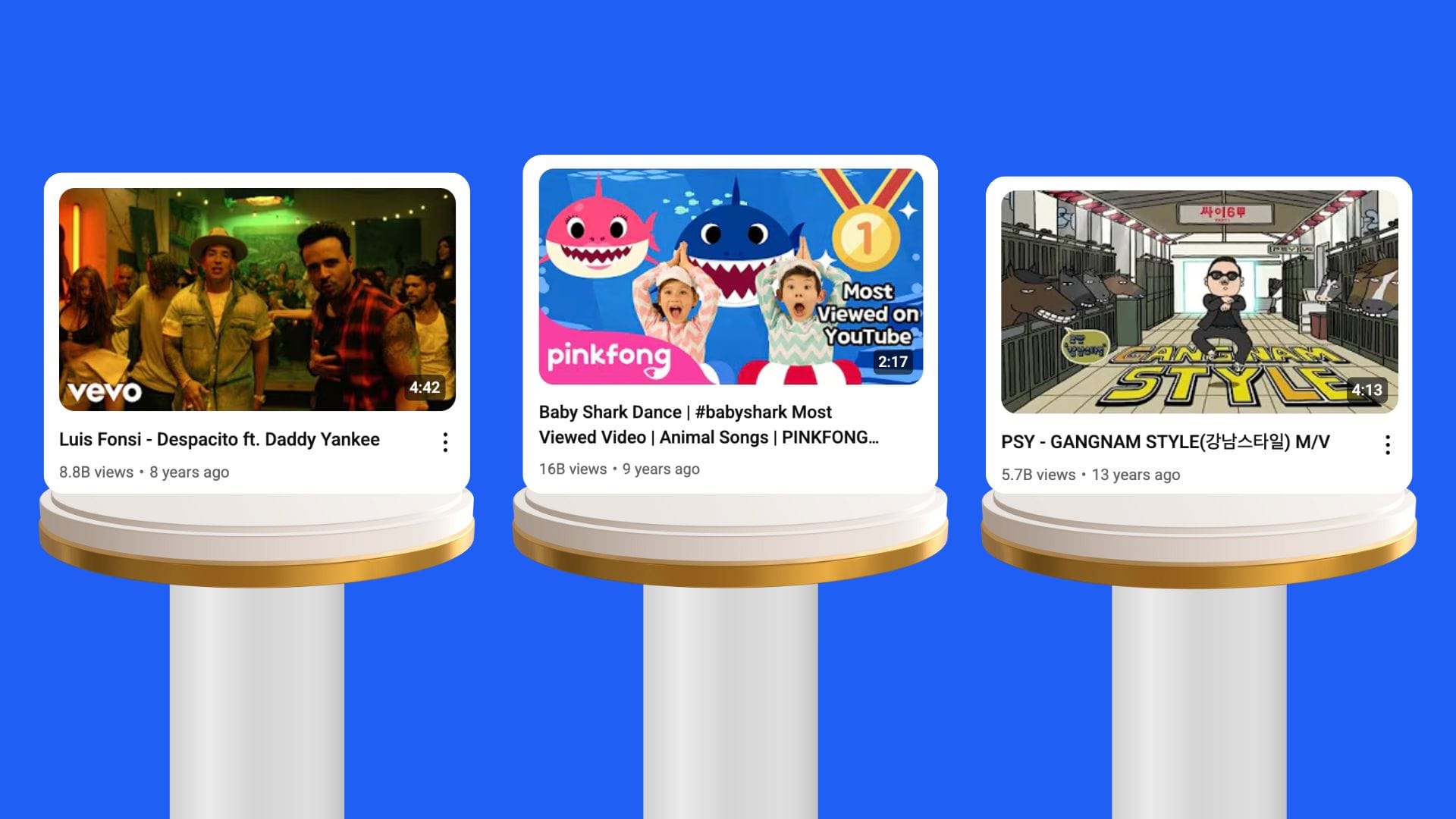
To understand how most YouTube videos views are achieved, we’ll break the analysis into three groups:
- Children’s content and repetition power – led by Baby Shark Dance.
- Music videos that conquered the world – the “Despacito” era and others.
- Unexpected outliers – viral hits that broke the mold.
Each section breaks down view mechanics, emotional psychology, packaging, and algorithm behavior.
Baby Shark and the Power of Repetition: How Children’s Content Took Over YouTube
The Reigning Champion of Most YouTube Views
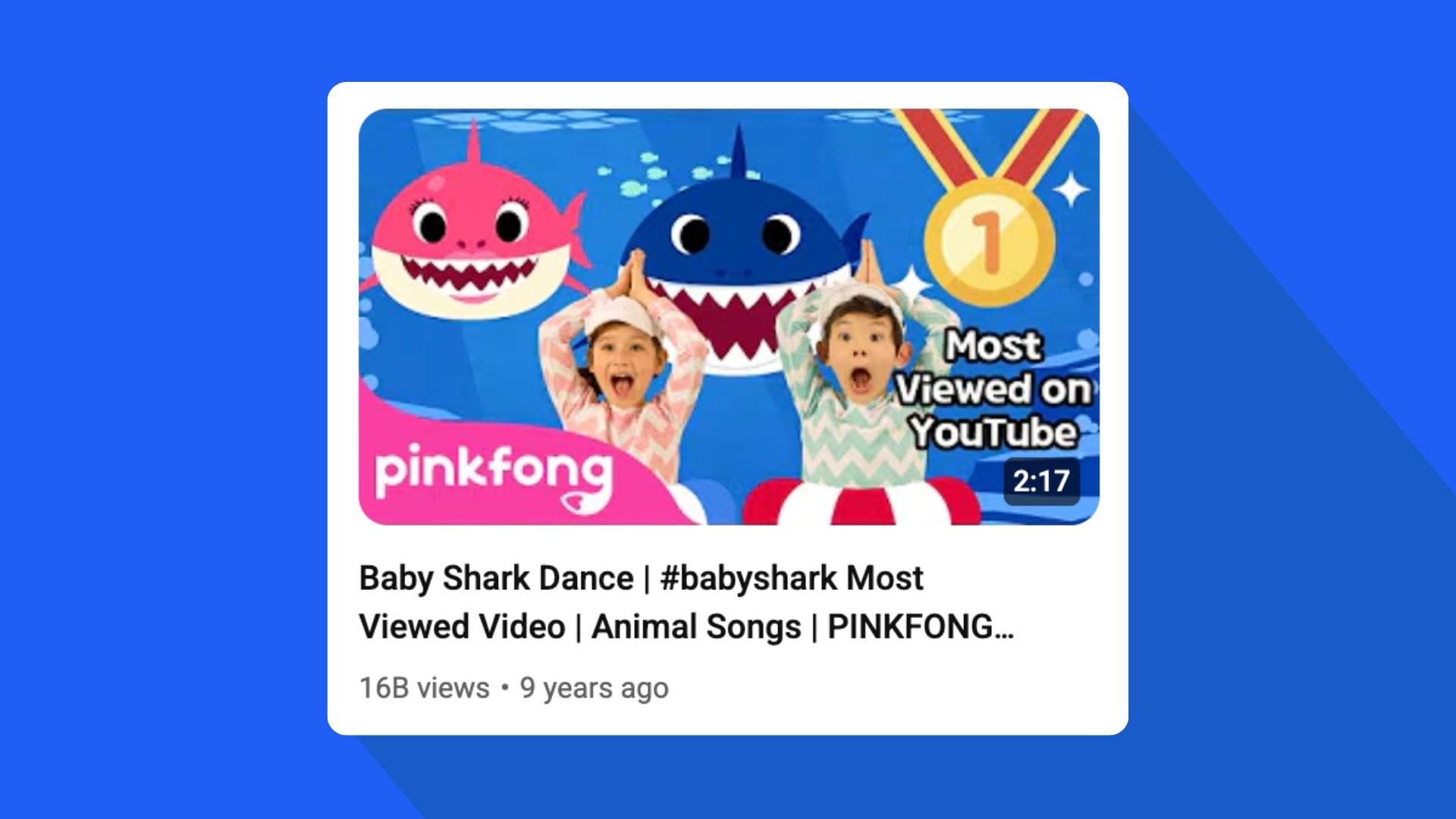
As of 2025, the most viewed video in YouTube history is Baby Shark Dance by Pinkfong, with more than 16 billion views. That’s double the global population and miles ahead of the next entry on the list. The clip is only two minutes long, but it has achieved what no big-budget music label or celebrity campaign could match: continuous daily growth across every region in the world.
So why did Baby Shark become the all-time leader in most YouTube videos views? The answer comes down to three overlapping forces: simplicity, replay value, and algorithmic bias.
1. Simplicity = Retention
Children’s media thrives on repetition. The structure of Baby Shark follows the exact rules used by early childhood educators:
- Short lines (two to four words per phrase).
- Predictable patterns.
- Movements attached to every lyric.
Each of those factors increases retention and recall. For YouTube, retention is gold. A viewer that watches a video to completion sends a strong signal to the recommendation algorithm. A viewer who replays it multiple times magnifies that signal.
Unlike adult viewers who browse unpredictably, children behave in loops. When they like a song, they replay it dozens of times in one sitting. This simple behavioral difference is why kids’ videos dominate charts for most YouTube videos views.
2. Visual Hooks That Never Tire
The visuals in Baby Shark Dance are designed to maintain attention without narrative. The bright color palette, simple backgrounds, and direct eye contact from the animated characters keep the viewer’s focus locked.
No frame is wasted on subtlety. Everything on screen moves with purpose: hand motions, character gestures, and rhythmic alignment with lyrics. The design is deliberate, using motion and contrast instead of complex editing to sustain engagement.
This “visual loop” principle is what modern creators can adapt. Even if you’re not making kids’ content, every scene in your video should have an energy shift, movement, camera change, or text, to reset attention.
3. High Replay Behavior Drives Exponential Growth
The replay rate is the multiplier that makes kids’ videos unbeatable. Adults may watch a music video twice. A five-year-old may watch Baby Shark ten times in a row.
Let’s quantify that.
If 10 million households play the same 2-minute song five times daily, that’s 100 million views per day, without new audience acquisition. Over a year, that scales beyond 36 billion potential impressions.
This habit loop is why the most YouTube videos views almost always include a children’s song. It’s not a fluke. It’s repeat consumption at a biological level: dopamine and predictability working together.
4. Cross-Cultural, Language-Neutral Appeal
Unlike songs that depend on lyrics or storytelling, Baby Shark transcends language. Its words are easy to pronounce, and its rhythm communicates meaning on its own. Pinkfong localized the song into more than ten languages, releasing versions for English, Korean, Spanish, and even Bahasa audiences.
Localization did more than expand audience reach, it fed the recommendation graph. When regional algorithms found local versions performing well, global YouTube began cross-linking them in “related videos.” That interconnected structure allowed the song to dominate watch loops across borders.
Creators can replicate this by producing content that communicates through universal signals, facial expressions, gestures, or visual metaphors rather than heavy dialogue.
5. Algorithmic Advantage of the Kids Category
YouTube heavily regulates children’s content under COPPA rules, but its algorithm still prioritizes engagement and viewer satisfaction. When a kids’ video performs well, YouTube’s family-friendly channels like Cocomelon, Little Baby Bum, and Pinkfong benefit from internal promotion within YouTube Kids.
This built-in ecosystem provides a consistent stream of impressions. Once a video gains traction, it becomes “sticky” in recommendation carousels for months or even years.
For creators outside the kids’ niche, the takeaway is structural: find ecosystems within YouTube (for example, Education, How To, Gaming) where recommendation persistence exists. Dominating one sub-category is often more valuable than competing across all of YouTube.
6. Branding and Asset Reuse
Pinkfong turned Baby Shark into a brand. The character designs, color palette, and typography appear across every derivative video. That consistency improves click-through rate (CTR) because users instantly recognize the brand before even reading the title.
Brand familiarity shortens decision time, which means faster clicks and higher CTR, one of YouTube’s biggest ranking signals.
Creators can use this same strategy: consistent fonts, tone, and thumbnails create pattern recognition that compounds over time. The audience builds trust subconsciously when every upload “feels” familiar.
7. Emotional Resonance Through Predictability
Adults associate emotion with novelty. Kids associate emotion with familiarity. The reason Baby Shark is comforting is that it’s predictable. The same verse structure and repetitive motions make it feel safe.
YouTube’s retention graph rewards safety more than surprise in this context. There are no drop-offs, no confusion, no negative comments, just positive reinforcement loops. That emotional comfort keeps parents pressing play and children asking for replays.
Even for non-kids creators, predictability in structure can build trust. The intro → main → payoff pattern helps viewers know what to expect, reducing friction to re-watch or binge.
8. Search and Discovery Optimization
When Baby Shark first appeared, Pinkfong optimized metadata aggressively:
- Repetition of searchable phrases (“Baby Shark Song,” “Baby Shark Dance,” “Baby Shark Kids Song”).
- Clear, family-safe keywords.
- Playlists combining similar titles to build session watch time.
The result was dominance in both search and suggested. It’s a case study in how keyword repetition plus playlist curation can push a video into “most viewed” status even years after upload.
For YouTube creators, targeting long-tail keywords related to behavior (e.g., “how to fix,” “learn,” “relax,” “study”) creates evergreen traffic the same way.
9. Monetization and Business Impact
Beyond YouTube’s ad revenue, Baby Shark generated billions in licensing, TV shows, toys, live tours. Each spin-off feeds the core video with new search traffic. Parents who buy merchandise often replay the original song with their kids, closing the loop.
For creators, this is a reminder that most YouTube videos views are part of broader ecosystems. If your video concept can live beyond the screen, products, community, course, or challenge, it sustains traffic longer.
10. What Every Creator Can Learn from Baby Shark
- Simplify your message. Make each scene communicate one thing clearly.
- Optimize for rewatch. End videos with satisfying loops or callbacks.
- Use consistent branding. Build instant recognition.
- Find sub-category algorithms. Get sticky in your niche’s recommendation engine.
- Leverage localization. Translations or subtitles multiply reach.
- Design emotion through rhythm. Repetition and pacing drive comfort or hype.
- Make metadata work. Intent-driven keywords win long-term visibility.
The formula works across niches because it aligns with basic human behavior: attention thrives on clarity and repetition. Baby Shark Dance isn’t just a kids’ song; it’s the clearest example of how predictability, accessibility, and design can dominate a global algorithm.
Music Videos That Crossed Billions: The Despacito Era and the Mechanics of Global Virality
Music dominates every chart of the most YouTube videos views.
Of the top 20 most-viewed videos on YouTube, over 70 percent are music videos. From Despacito to Shape of You and See You Again, the platform’s largest numbers come from repeat listening and universal sound.
But why music? Why do people who can stream the same track on Spotify choose to watch the video on YouTube billions of times? The answer is simple: YouTube turned music into a visual experience. Every click carries both audio and emotion, making replaying the video more rewarding than a passive listen.
1. Despacito: The Benchmark for Billions
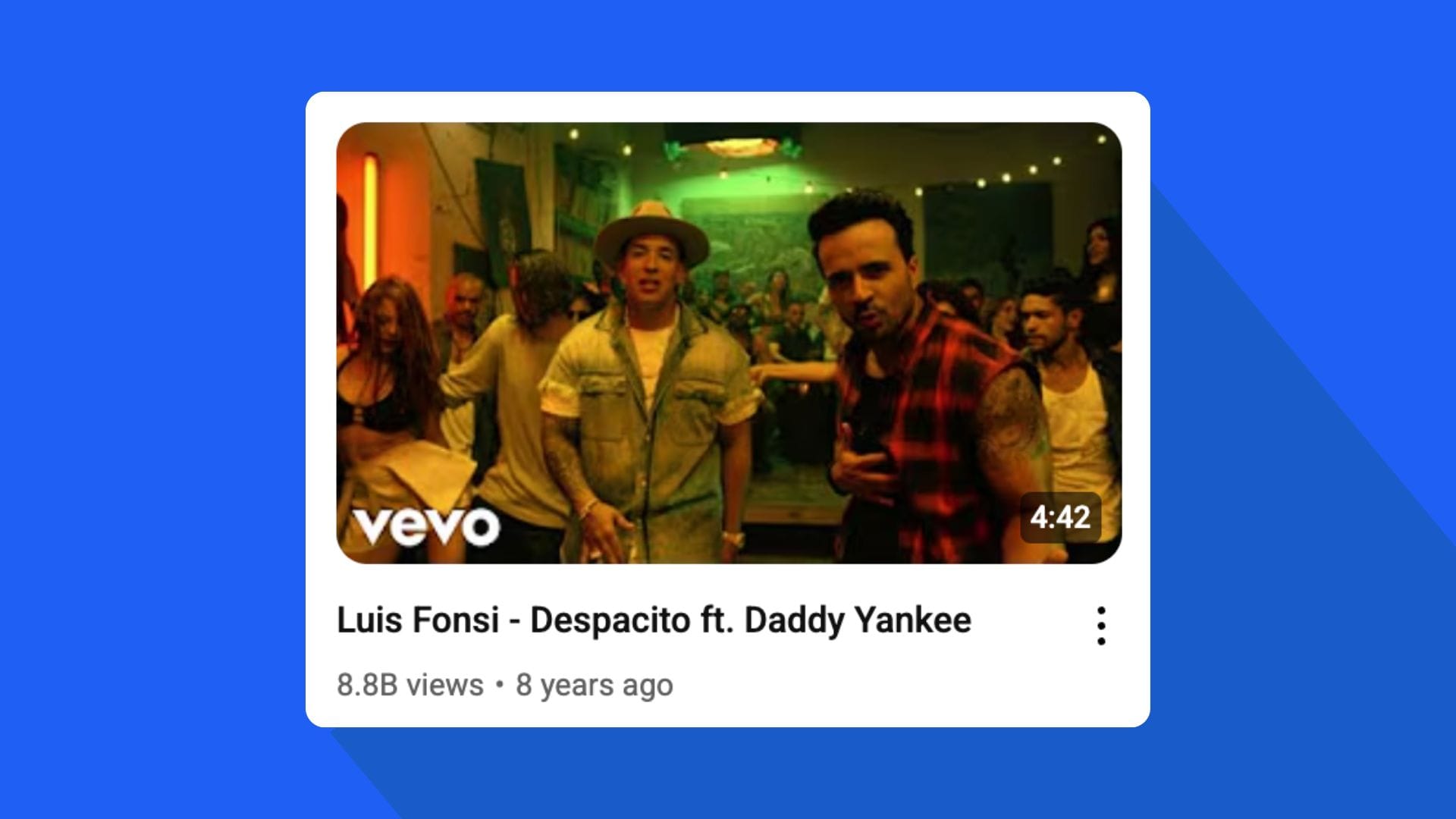
When Despacito launched in 2017, it became a global case study in digital virality. Within 97 days, it hit one billion views, breaking the previous record held by Gangnam Style. By August 2017, it became the first video in history to reach three billion views. Today, it sits comfortably among the top 10 most-viewed videos of all time, with more than 8 billion plays.
A Song Built for Universality
Unlike most pop songs, Despacito was never meant for one market. Its rhythm – reggaeton – was familiar enough for Western audiences but still carried Latin authenticity. The production relied on a tempo that made it danceable across cultures.
The Spanish lyrics didn’t limit its reach. Instead, they enhanced its mystique. Non-Spanish speakers found the sound infectious, while Spanish-speaking listeners embraced a moment of cultural pride.
Collaborations That Broke Barriers
The Despacito (Remix) featuring Justin Bieber exploded the song’s global visibility. Collaborations create network effects, each artist brings their own audience, and algorithms merge both into shared recommendation loops. The Bieber remix helped Despacito dominate both English and Latin charts simultaneously, driving searches like “most YouTube videos views music” to one result again and again.
High Replay Value
The hook (“Despacito…”) acts like a reset point every 30 seconds. The listener always has something familiar to anticipate. This micro-structure increases watch time and encourages repeat plays. For YouTube’s algorithm, replay frequency and completion rate combine to signal satisfaction. That pushed Despacito deeper into recommendations long after radio rotation ended.
2. The Visual Strategy Behind Music Virality
Music videos don’t just accompany the sound, they amplify it visually. Despacito was filmed in La Perla, Puerto Rico, capturing local energy and culture. The vibrant visuals turned it into a postcard of joy.
Authenticity and Color
Audiences sense authenticity instantly. The raw, street-level environment made viewers feel the rhythm rather than observe it. YouTube’s compression of cultural realism made the video distinct from over-produced Western pop.
Contrast and Motion
Every shot in Despacito moves. The camera never rests, tracking, panning, and dancing with the beat. In music videos, motion becomes rhythm reinforcement. When the brain hears rhythm and sees movement aligned, retention rises. That visual rhythm increases the chance of full playback, improving the video’s completion metrics.
Thumbnails and Branding
The Despacito thumbnail uses a warm color palette – reds, yellows, and skin tones – which subconsciously evoke energy and warmth. The artists’ faces are clear, making identity instant. When a viewer scrolls, recognition is the only conversion metric that matters.
3. The Algorithm Loves Music
YouTube treats music differently. It has entire subsystems, like YouTube Music and topic channels – dedicated to surfacing songs. Once a track gains traction, it receives algorithmic persistence far longer than commentary or entertainment content.
Music videos also benefit from multi-source traffic:
- Search traffic from users looking for lyrics, karaoke, or remixes.
- Suggested traffic from genre and artist watch loops.
- External traffic from social media embeds and music blogs.
This multi-channel inflow makes music videos dominant in the most YouTube videos views category.
4. See You Again: Emotional Anchoring and Context
See You Again by Wiz Khalifa ft. Charlie Puth is another key example. Released in 2015 as a tribute to actor Paul Walker in Fast & Furious 7, it became a universal anthem for loss and remembrance.
Emotion as Retention
The video doesn’t rely on spectacle; it’s grounded in grief and nostalgia. Every view carries emotional weight. People replayed it to feel connection, not entertainment. Emotional intensity drives re-watching more powerfully than novelty.
Context Matters
The link to Fast & Furious gave See You Again built-in global reach. The film series already had millions of fans worldwide. The song extended that audience into YouTube – another example of using cross-platform ecosystems to dominate metrics.
Visual Minimalism
Unlike Despacito, See You Again uses minimal cuts and neutral backgrounds. That reduction draws focus to the lyrics and emotion. When the sound carries the meaning, simplicity in visuals prevents distraction, increasing the likelihood of full playthroughs.
5. Shape of You: Algorithmic Design Meets Musical Math
Ed Sheeran’s Shape of You is the blueprint for modern algorithm-friendly songwriting. Its percussion-driven beat, looped hook, and vocal rhythm sit perfectly between dance and acoustic pop – a hybrid style that maximizes global relevance.
Predictable Surprise
The song introduces subtle shifts every 30 seconds, keeping listeners engaged without overwhelming them. That pacing mirrors YouTube retention curves, where attention dips every 20–40 seconds if no variation occurs.
Multi-Platform Amplification
Before its official video dropped, lyric and dance versions flooded the platform. Each one drove traffic back to the main upload. This ecosystem effect – multiple pieces of related content – built a network of interlinked watch sessions.
Thumbnail & Metadata Consistency
All uploads shared similar titles and thumbnails. That consistency improved click-through rates across regions and languages. When searchers typed “Shape of You lyrics,” YouTube automatically promoted the official video higher because it dominated engagement metrics in every variation.
6. The Power of Cultural Fusion
Music that tops the most YouTube videos views list often merges cultural elements. Gangnam Style fused Korean pop with global humor. Despacito fused Latin rhythm with Western pop. Shape of You fused acoustic intimacy with club percussion.
This fusion increases algorithmic reach:
- Broader potential audience.
- Cross-language collaborations that multiply watch pools.
- Trend adoption – each culture shares the video for different reasons.
Creators outside music can learn from this – mixing genres or tones (education + entertainment, gaming + storytelling) increases discoverability.
7. Engagement Loops: Why People Rewatch Music
Music triggers emotional and physiological responses that naturally cause repetition. Dopamine release from rhythm and melody creates a loop of satisfaction. The brain anticipates the chorus, rewarding each repeat.
YouTube’s algorithm interprets that as high viewer satisfaction. Replays count as fresh views, inflating totals faster than any other content type. This is the secret behind why nearly every most YouTube videos views entry is a song.
8. Community and Remix Culture
Music invites participation. Viewers don’t just watch; they react, remix, dance, and translate. That user activity feeds back into visibility. Reaction videos, choreography tutorials, and cover versions act as organic marketing.
Example ripple effects:
- Despacito dance challenges on TikTok and Instagram.
- Shape of You acoustic covers on YouTube.
- See You Again tribute montages from fans.
Each derivative work links back to the original, signaling relevance and keeping the video evergreen in recommendation loops.
9. Thumbnail, Title, and Metadata Optimization
Even billion-view videos rely on classic SEO principles.
- Title simplicity: “Artist – Song Name (Official Music Video)” remains the most search-efficient format.
- Keyword relevance: pairing “official video” or “lyrics” increases search click-throughs.
- Thumbnail clarity: close-up of the artist’s face + strong color contrast.
This format performs best in YouTube’s right-hand suggestion bar and mobile feeds.
10. What Creators Can Learn from Music’s Dominance
- Emotional Trigger First. Every viral video starts with a feeling – joy, sadness, energy, awe.
- Rhythmic Editing. Align cuts or camera shifts with auditory beats to sustain attention.
- Cross-Platform Distribution. Promote snippets or remixes on TikTok, Shorts, and Instagram Reels.
- Predictable Structure. Repetition with micro-variation keeps viewers in flow.
- Collaborations Drive Reach. Two audiences = double exposure.
- Cultural Blending. Borrow visual or rhythmic cues from multiple cultures.
- Consistency in Packaging. Uniform thumbnails and metadata compound recognition.
- Encourage User Interaction. Challenges and covers extend visibility beyond the main video.
- Optimize Titles for Intent. Use phrasing people naturally search for.
- Create Emotionally Charged Visuals. Every frame should express the mood of the sound.
11. Why Music Will Keep Dominating the Most-Viewed Charts
Music has the three things the algorithm values most: consistency, universality, and replayability. It crosses every demographic and linguistic barrier. Whether a viewer is in Seoul, São Paulo, or Seattle, rhythm requires no translation.
As AI, recommendation models, and streaming habits evolve, music videos remain the purest expression of repeatable content. They are evergreen, globally relevant, and inherently viral.
Summary of Lessons from the Despacito Era
| Element | Why It Matters | Creator Takeaway |
|---|---|---|
| Repetition | Builds recognition and comfort | Structure content around recurring hooks |
| Collaboration | Expands algorithmic reach | Partner with aligned creators |
| Cultural Fusion | Multiplies markets | Blend global & niche styles |
| Emotion | Drives retention | Anchor stories in real feelings |
| Visual Movement | Matches rhythm | Use kinetic editing |
| Simplicity in Metadata | Improves CTR | Keep titles short & clean |
| Community Participation | Sustains visibility | Encourage remixes & challenges |
Music videos earned their spot in most YouTube videos views not by accident but by aligning perfectly with human behavior – emotion, rhythm, and repetition.
Next comes the wild card category: the outliers. The videos that broke through without music, celebrity, or studio budgets. These are proof that creativity and timing can still beat production scale.
Outliers and Unexpected Hits: How the Internet Still Surprises YouTube Every Year
Music and kids’ videos dominate the charts, but they aren’t the whole story. Some of the most viewed YouTube videos of all time started as outliers, creations that had no marketing plan, no record label, and no algorithm advantage. They went viral because they triggered something deeper in people: laughter, curiosity, or pure human connection.
These are the videos that remind everyone why YouTube exploded in the first place. They prove that storytelling, timing, and authenticity still matter more than polish.
1. The Original Viral Blueprint: Gangnam Style
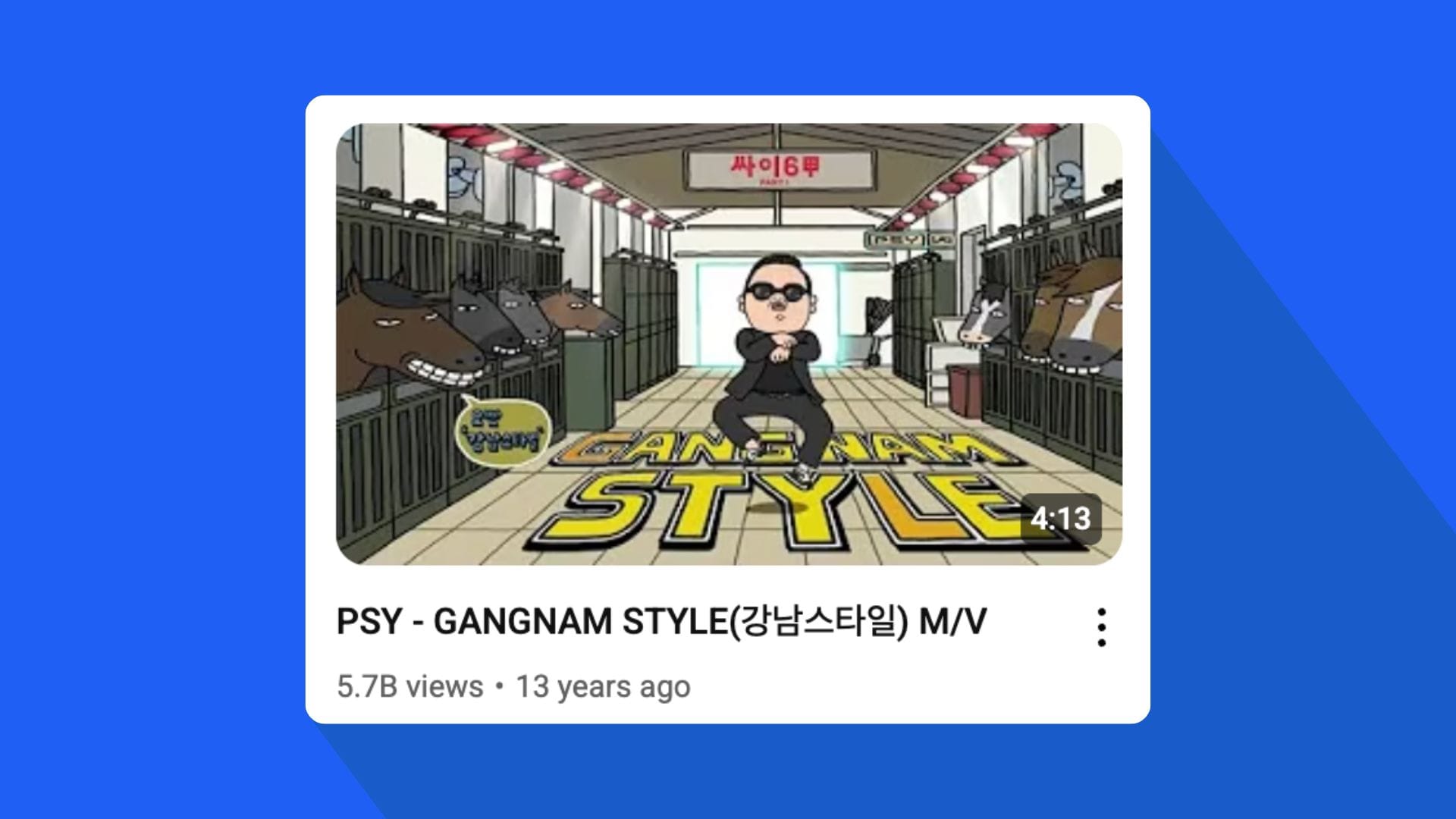
Before Despacito, there was Gangnam Style. When it launched in July 2012, YouTube had never seen anything like it. A K-pop song in Korean language broke every global boundary, becoming the first video ever to reach one billion views.
Why It Worked
- Novelty at Scale. Nobody had seen Korean pop culture mixed with absurdist humor and choreographed dance moves like this. The horse dance became a global meme overnight.
- Instant Meme Potential. Every shot was exaggerated enough to inspire parodies. The humor translated without language, which made it perfect for sharing.
- Global Curiosity. Western audiences were discovering K-pop for the first time. Gangnam Style gave them an entry point, funny, catchy, and visually weird.
- Algorithm Boost. YouTube’s recommendation system was still in its early discovery phase. Engagement was high, and competition for watch time was low, so one viral loop could dominate global traffic for weeks.
Cultural Lesson
Virality often happens at the intersection of familiarity and absurdity. The rhythm felt familiar (dance music), but everything else, the visuals, the humor, felt fresh. That balance of known and unknown is still what drives modern virality.
2. Evolution of Dance: Simplicity and Universality
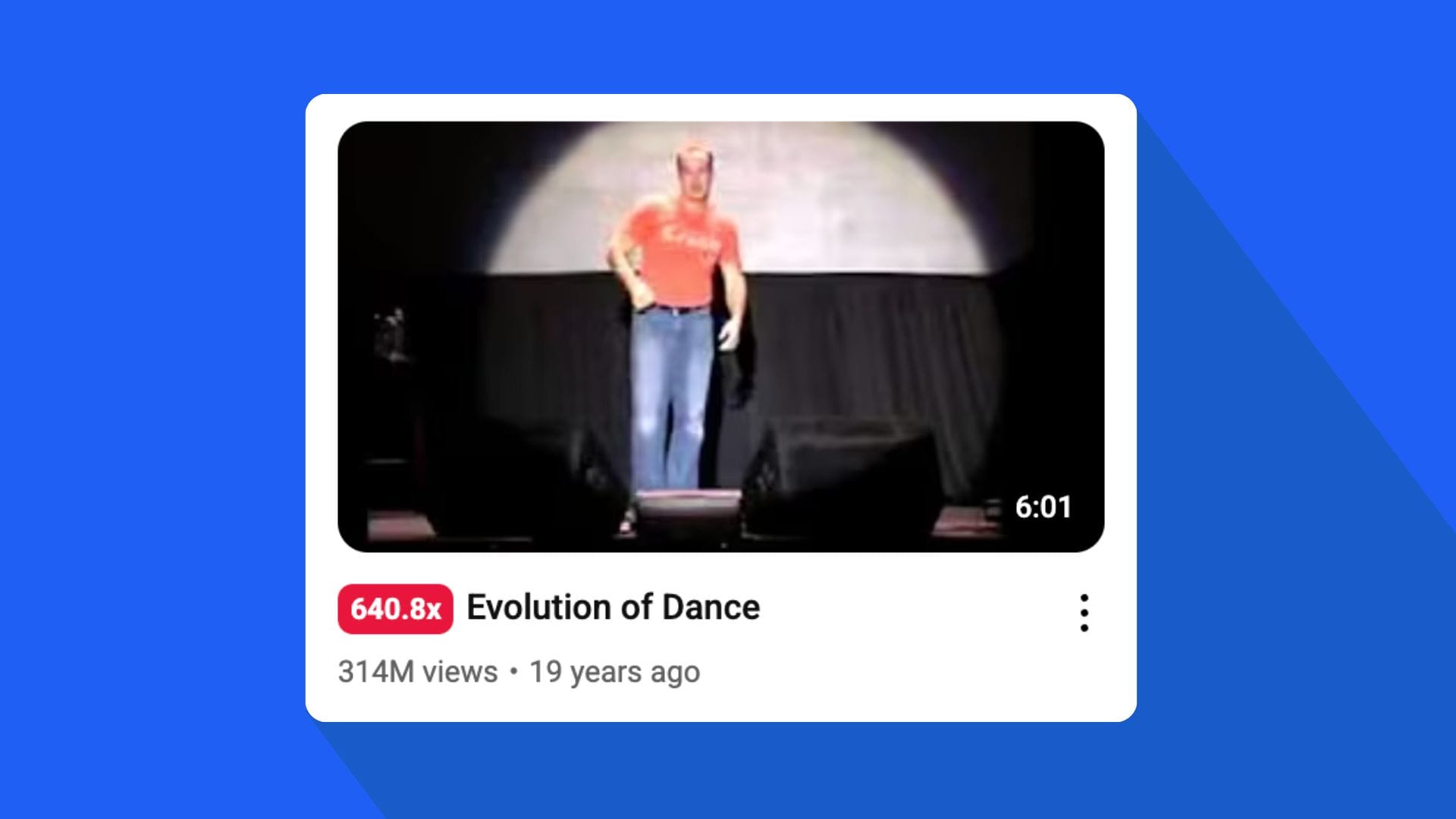
Before algorithms, there was Evolution of Dance. Uploaded in 2006 by Judson Laipply, it became one of the first videos to pass 100 million views.
Why It Worked
- Simple Concept, Immediate Payoff. A single performer dancing through decades of music, easy to understand within seconds.
- Cultural Nostalgia. Every song sparked a memory for someone. It invited participation: viewers laughed, remembered, and shared.
- Authenticity Over Production. There was no editing trick, no studio lighting, no marketing. Just one person performing confidently.
The Human Element
What made Evolution of Dance special was humanity. It captured something every viewer could relate to, joy through movement and music. That universal connection transcends trends.
Relevance Today
Short-form content today mirrors Evolution of Dance. Quick, understandable ideas that deliver emotion fast dominate platforms like Shorts, Reels, and TikTok. The blueprint hasn’t changed, only the length and format.
3. Charlie Bit My Finger: Relatability as Virality

Few videos show the power of relatability like Charlie Bit My Finger. Two brothers sitting on a couch. One bites the other’s finger. That’s it. Yet it reached over 880 million views before being taken private after an NFT auction.
Why It Worked
- Genuine Emotion. Laughter, surprise, pain, all in under one minute.
- Real Family Dynamics. It wasn’t staged, scripted, or polished. People saw a slice of real life.
- Rewatch Value. The moment is short and funny, encouraging instant replays.
- Shareability. It’s safe, wholesome, and universally understandable. No translation needed.
Why the Algorithm Loved It
Even in the early YouTube era, engagement mattered. Charlie Bit My Finger had near-perfect retention, everyone watched the entire clip. That completion rate told YouTube the video satisfied viewers, ensuring constant recommendation in early homepages.
Lesson for Modern Creators
Raw emotion still outperforms perfection. In a world flooded with polished production, authenticity cuts through. A simple, relatable moment can outperform any studio-grade shoot if it triggers empathy or laughter.
4. MrBeast and the Rise of Modern Outliers
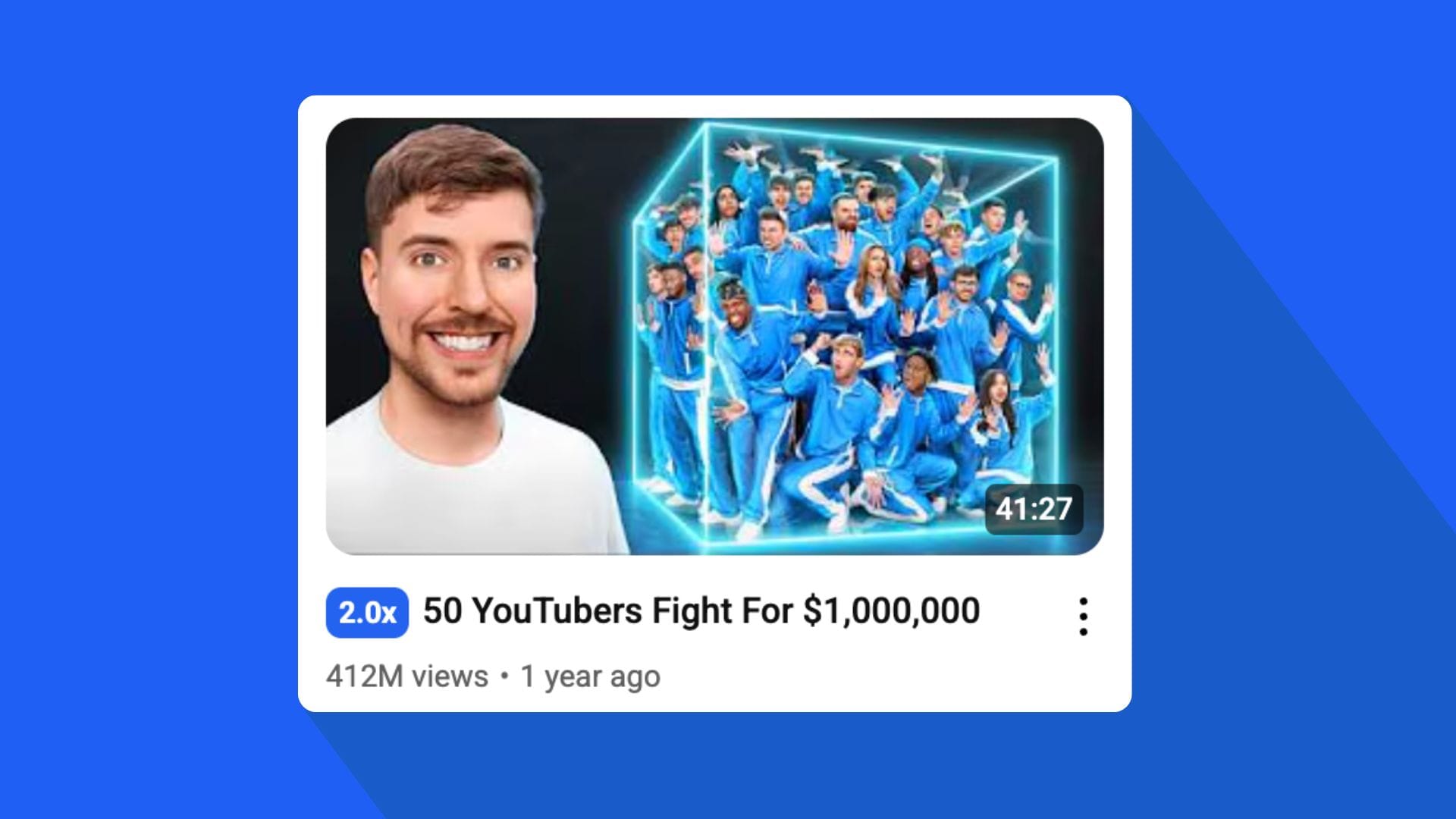
Today’s YouTube outliers look different, but they follow the same core principles: shock, generosity, and human connection. MrBeast’s large-scale challenges regularly achieve hundreds of millions of views, showing that even algorithm-savvy modern creators use emotion first, production second.
Why His Videos Work
- Immediate Hook. Every video starts with the premise in the first five seconds: “I gave $1,000,000 to random people.”
- Emotional Reward. Viewers watch for payoff, not surprise. There’s always closure.
- Visual Scale. Large environments and groups keep attention visually dynamic.
- Community Participation. Audiences feel like part of the mission, creating repeat engagement.
Algorithmic Dominance
MrBeast optimizes for CTR, retention, and satisfaction, the modern version of viral math. Yet at its core, his formula mirrors Charlie Bit My Finger and Evolution of Dance: clear concept, real emotion, universal appeal.
5. The Role of Emotion in Viral Outliers
Emotion remains the main driver behind videos with the most YouTube views. Data from multiple studies on social sharing shows that high-arousal emotions, whether joy, awe, or anger, make people share faster and remember longer.
The Emotional Triggers Behind Every Viral Outlier
| Emotion | Example | Effect on Viewers |
|---|---|---|
| Joy | Evolution of Dance | Encourages sharing, laughter |
| Surprise | Gangnam Style | Creates memory imprint |
| Empathy | Charlie Bit My Finger | Builds connection |
| Awe | MrBeast Challenges | Sustains retention |
| Nostalgia | Early meme videos | Replays for comfort |
Viral videos rarely succeed through logic. They bypass reasoning and strike instinct. When creators focus on designing emotional responses instead of surface trends, they produce work that outlives the algorithm cycle.
6. Timing and Platform Evolution
Each viral hit existed because of timing. The algorithm, audience behavior, and social media ecosystem of its era shaped how quickly it spread.
- Evolution of Dance succeeded before major competition existed.
- Gangnam Style used Facebook sharing as fuel.
- Despacito leveraged embedded plays and global collaborations.
- Modern creators like MrBeast thrive through watch-time optimization and Shorts discovery.
Understanding the platform era you’re in is crucial. The same concept released at the wrong time might underperform by millions of views.
7. Thumbnail Psychology for Outliers
Thumbnails for viral hits share one trait: immediate emotion.
- Gangnam Style: PSY mid-dance, high energy.
- Charlie Bit My Finger: two kids laughing, instantly readable.
- Evolution of Dance: mid-movement, full expression.
Each thumbnail communicates the tone before the viewer reads the title. For creators chasing high views, thumbnails shouldn’t summarize, they should evoke.
8. Title Structure for Viral Performance
Viral titles use simplicity and curiosity. Examples:
- “Gangnam Style (강남스타일) M/V” – includes native language + global identifier.
- “Charlie bit my finger – again!” – short, casual, emotional.
- “Evolution of Dance” – pure descriptive clarity.
None of these rely on clickbait. They match intent with authenticity. The lesson: make your title sound like how a friend would describe it in conversation.
9. Algorithmic Mechanics of Virality
Every viral video, from 2006 to 2025, follows the same mechanical sequence inside YouTube’s system.
- Initial Spike. Rapid CTR and retention in the first 24 hours signal quality.
- Feedback Loop. Comments and replays feed the satisfaction model.
- Broadened Recommendations. YouTube tests to wider audiences; high engagement multiplies reach.
- Cultural Loop. Shares on social platforms push traffic back to YouTube.
- Sustained Discovery. Search and suggestion maintain residual growth for years.
Even a small outlier can snowball if it meets these triggers.
10. The Anatomy of an Outlier: A Repeatable Formula
Analyzing these iconic videos reveals a repeatable structure behind the most YouTube videos views.
| Phase | Description | Creator Application |
|---|---|---|
| Hook | Instant understanding within 5 seconds | State your premise early |
| Emotion | Trigger joy, awe, or empathy | Use authentic reactions |
| Shareability | People can explain it fast | Simplicity > complexity |
| Replayability | Short or loopable format | Design satisfying payoffs |
| Accessibility | Language-free or easy context | Use universal visuals |
| Timing | Matches cultural moment | Release when topic is hot |
| Packaging | Strong thumbnail & title harmony | Evoke emotion visually |
This isn’t a secret formula, it’s the natural structure of human attention online.
11. How Outliers Age Differently Than Music or Kids Content
Music and children’s videos maintain views through replay loops. Outliers depend on cultural nostalgia and discoverability. Their spikes are steep, but long-tail traffic can stay active for over a decade because of search and curiosity.
Examples:
- Gangnam Style still earns hundreds of thousands of views monthly due to nostalgia.
- Charlie Bit My Finger inspired countless memes and references even after being delisted.
- Evolution of Dance remains a time capsule for early YouTube culture.
Creators can use this model to plan both short-term virality and long-term evergreen content.
12. Modern Outlier Opportunities
Today’s platform dynamics favor niche mastery and algorithm hacking, but outliers still emerge. The difference is that modern virality relies on remix culture.
Potential outlier formats include:
- Community Experiments: interactive challenges where viewers control outcomes.
- Social Reactions: capturing unfiltered emotional moments.
- Micro-Documentaries: single-day builds or achievements compressed into 60 seconds.
- Unexpected Skills: niche talents that surprise audiences.
- Pattern Breakers: content that disrupts common expectations in a genre.
Creators chasing massive reach should study how to break rhythm, not through shock, but by disrupting predictability in the first 10 seconds.
13. Key Takeaways from Outlier Success
- Human beats algorithm. Every viral hit starts with emotion, not data.
- Simplicity scales. The less explanation required, the higher the reach.
- Relatability drives retention. Audiences rewatch what feels real.
- Packaging matters. A strong thumbnail-title combo multiplies organic discovery.
- Timing wins. Align with cultural trends or emotional cycles.
- Emotion outlasts novelty. People remember how you made them feel, not how you edited.
- Design for shareability. Ask, “Would someone text this to a friend?”
- Shorter often performs better. Completion rate is more important than length.
- Encourage remixes. Reactions and reuploads keep videos alive.
- Let authenticity lead. Overproduction can sterilize emotion.
14. Outliers and the Future of Viral YouTube Content
As AI tools democratize production, creativity becomes the differentiator again. Anyone can make polished videos, but few can make people feel something real.
Future outliers will likely merge real emotion with smart technology, AI-assisted storytelling that still feels human. They’ll use faster editing, adaptive music, and data-informed hooks, but the spark will still come from instinct and honesty.
15. The Big Picture
The most viewed YouTube videos, kids’ songs, music, or outliers, all share the same DNA: they connect emotionally, scale easily, and align with platform mechanics. But outliers hold a special place. They remind us that unpredictability still rules the internet.
No algorithm can manufacture charm, surprise, or human warmth. That’s why, even with billions of hours of content uploaded each year, the next Charlie Bit My Finger could come from anywhere, a bedroom, a park, or a phone in someone’s pocket.
Final Thoughts
The most YouTube videos views list isn’t a monument to production budgets. It’s a map of what humanity finds interesting, funny, and moving. The early outliers proved you don’t need celebrity or infrastructure. You just need timing, authenticity, and emotion packaged in a way that clicks instantly.
Whether you’re building the next viral masterpiece or studying the past, remember what these videos showed the world: virality is predictable only in hindsight.
Turning Insight Into Action: How To Use AI To Create Your Next Viral Video
The creators behind the most viewed YouTube videos in history didn’t rely on luck. Each one followed patterns rooted in psychology, structure, and packaging. They understood what drives people to click, watch, and share.
But understanding why something worked is only half the game. The real growth happens when you take those insights and apply them systematically to your own content.
That’s where strategy meets execution.
1. Apply the Patterns of Virality to Your Own Channel
Every video that’s broken into the most YouTube videos views list shares three consistent traits:
- A clear hook. Viewers must understand what the video is about within the first five seconds.
- A strong emotional pulse. Joy, surprise, awe, or empathy.
- A repeatable formula. Familiarity, rhythm, and structure that the brain can follow.
These aren’t coincidences, they’re predictable behaviors. The algorithm rewards videos that hold attention, deliver emotion, and encourage replays.
If you want to reverse-engineer the same momentum, focus on these fundamentals:
- Start with one compelling idea.
- Package it with a scroll-stopping title and thumbnail.
- Deliver a clear emotional outcome that makes viewers share it.
That’s the exact framework that tools like 1of10’s Idea Generator and Title Generator are built around.
2. How to Find What’s Working Right Now
The easiest way to make videos that perform like the top 1% is to study what’s performing today, not last month, not last year.
The top creators you see at the top of the most YouTube videos views chart have teams constantly analyzing trends. They find outliers before the rest of the market reacts.
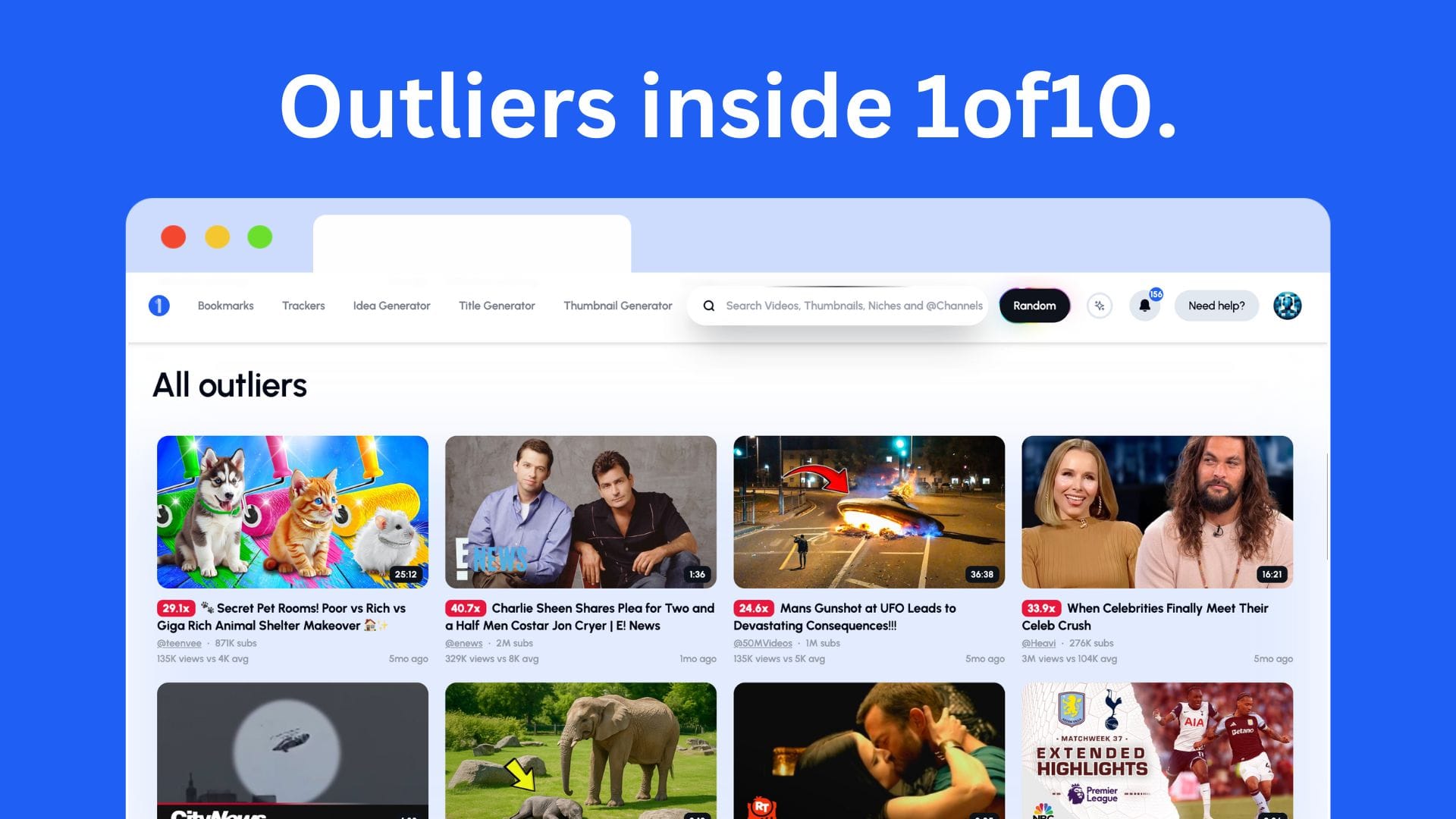
With 1of10’s Outlier Search, you can see real-time spikes in videos across YouTube. It shows you which topics, titles, and thumbnails are breaking through right now. Instead of guessing, you can filter by niche, region, or creator size, and spot patterns that reveal what audiences are already responding to.
This is how you stay ahead of trends before they peak.
3. Packaging Determines Everything
The difference between a video that gets 10,000 views and one that gets 10 million usually isn’t the content, it’s the packaging.
Even Despacito and Baby Shark succeeded because of packaging clarity. The title said exactly what the viewer would get. The thumbnails were recognizable, clean, and emotionally charged.
If your video idea or message isn’t framed to capture attention, it doesn’t matter how good the idea is.
That’s why your title and thumbnail need to be tested, refined, and optimized before you hit publish.
You can test yours with 1of10’s Thumbnail Generator and Title Generator. These tools use real data patterns from high-performing YouTube videos to generate options that fit your channel’s tone and audience behavior.
Run five ideas. See which titles hook fastest. Pick the combination that gives you the best shot at clicks.
4. Build Systems, Not One-Offs
The creators who dominate YouTube don’t chase virality, they build systems that produce it repeatedly.
Each new upload is a small experiment. They track what performs, then refine their content pillars, packaging, and pacing. Over time, their average floor rises.
If you want your own system:
- Use Tracked Channels to follow your competitors and benchmark what’s working in your niche.
- Bookmark their best titles and thumbnails to build your inspiration library.
- Analyze their frequency, topic clusters, and pacing patterns.
It’s not about copying, it’s about pattern recognition. When you see what’s working consistently, you can adapt the principles to your own style.
5. Stop Guessing What Will Work
Every creator faces the same challenge: coming up with the next “banger.” You brainstorm for hours, draft scripts, and second-guess every title.
That process burns time.
Instead, use data-driven ideation. 1of10’s Idea Generator gives you creative prompts based on the same patterns found in videos with the most YouTube views.
You can start with a keyword, trend, or niche, and get dozens of unique video ideas tied to proven performance data.
This turns idea generation from chaos into a repeatable workflow, something every full-time creator eventually needs.
6. Connect Strategy to Execution
Studying the most viewed videos in YouTube history teaches strategy. But real growth happens when you connect that strategy to execution.
Let’s recap the steps:
- Use Outlier Search to see what’s trending right now.
- Generate ideas that fit your audience.
- Test title and thumbnail variations.
- Post, analyze, and refine.
This loop mirrors how channels like MrBeast operate, test, measure, improve, repeat.
With 1of10, that loop takes minutes, not hours. You replace guesswork with real-world trend data and turn analysis into action.
7. Where to Go Next
If you’re serious about building videos that reach the most YouTube videos views, start small. Run one experiment this week.
- Pick a video idea you’ve been sitting on.
- Use 1of10 to generate five title options.
- Create a thumbnail variation with the editor.
- Post it and track your CTR.
Document what happens. Repeat the process with each upload. You’ll see patterns emerge fast.
Once you identify what works, scale it. Turn those learnings into templates, formats, and systems. That’s how you build predictable performance.